OECD Tourism 2026: Colombia Makes Peace Through Tourism Mainstream

The OECD Tourism Trends and Policies 2026 report has elevated Peace Through Tourism from an idealistic concept to official public policy by showcasing Colombia’s national strategy. The recognition could inspire destinations worldwide to use tourism as a tool for reconciliation, community rebuilding, historical memory, and sustainable economic development.
The OECD (Organization for Economic Co-operation and Development) is a forum and knowledge hub for data, analysis and best practices in public policy. We work with over 100 countries across the world to build stronger, fairer and cleaner societies – helping to shape better policies for better lives.
For decades, Peace Through Tourism has largely existed on the margins of global tourism policy—celebrated in conference speeches, academic discussions and occasional destination marketing campaigns, but rarely embedded in national tourism strategy.
That may have changed.
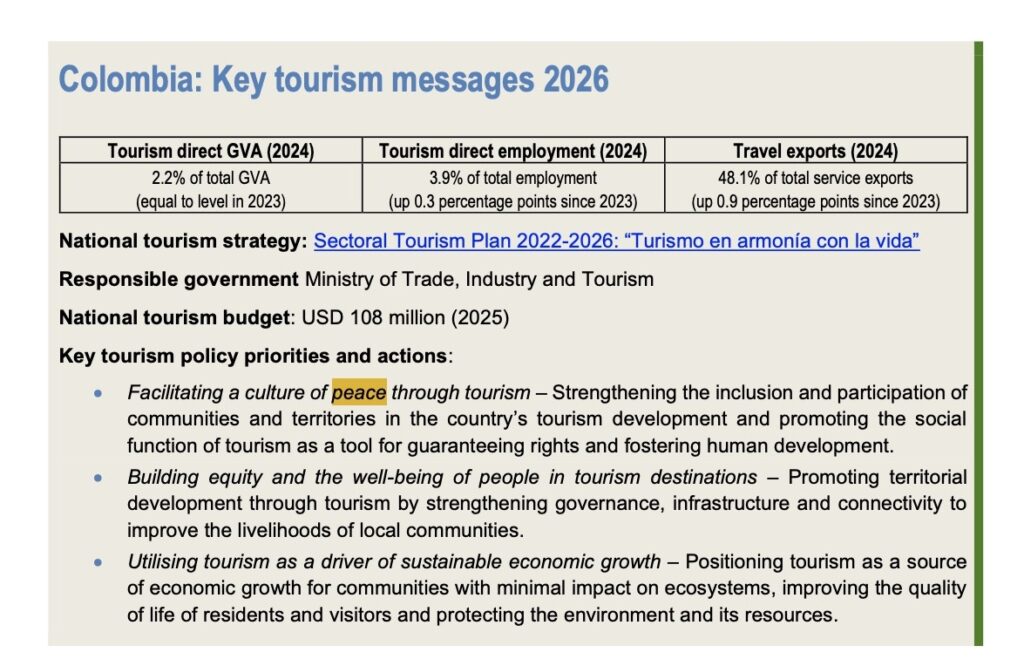
With the publication of the OECD Tourism Trends and Policies 2026 (PDF) report on 1 July, one of the world’s most influential economic policy organizations has effectively elevated Facilitating a Culture of Peace Through Tourism into mainstream tourism policy by highlighting Colombia’s comprehensive national strategy as a model worthy of international attention.
The significance extends well beyond Colombia.
It marks the first time that an OECD member has presented Peace Through Tourism not merely as a symbolic aspiration but as a measurable tourism development program with dedicated investment, branding, institutional support and documented economic outcomes.
A Remarkable Transformation
OECD lists Colombia as first country to build Culture of Peace Through Tourism
Bangkok — The concept of Facilitating a Culture of Peace Through Tourism is all set to hit mainstream after being prominently highlighted as a…
Few countries illustrate tourism’s transformative power better than Colombia.
For decades, international headlines associated the country with drug cartels, armed conflict and security concerns. Large areas of the country remained inaccessible to both domestic and international visitors.
Today, Colombia has become one of Latin America’s fastest-growing tourism destinations, welcoming a record 7.1 million international visitors in 2024, according to the OECD. Tourism now contributes 2.2% of national Gross Value Added, supports nearly 900,000 jobs, and accounts for almost half of Colombia’s service exports.
But economic recovery tells only part of the story. The OECD identifies one policy priority above all others:
Facilitating a culture of peace through tourism.
Rather than treating tourism simply as an economic sector, Colombia positions it as an instrument for reconciliation, social inclusion and territorial reconstruction.
Tourism as Social Reconstruction

According to the OECD report, Colombia’s strategy seeks to strengthen communities previously affected by decades of armed conflict through tourism experiences that:
- preserve historical memory,
- strengthen local economies,
- promote a culture of peace,
- rebuild the social fabric.
The numbers demonstrate that this is far more than a marketing slogan.
The OECD reports that:
- more than USD 4 million has been invested;
- over 480 tourism enterprises and productive units have entered tourism supply chains;
- beneficiaries include victims of armed conflict, former combatants, demobilized persons and communities replacing illicit crop production;
- 774 entrepreneurs have earned authorization to use the “Colombia, Destinations of Peace” label;
- 903 peace-related tourism businesses have been cataloged;
- 100 tourism experiences have been strengthened;
- four Peace and Memory Tourism Corridors have been created;
- a national Tourism Network of Destinations of Peace has been established.
No other OECD country profile presents such a comprehensive Peace Through Tourism framework.
More Than a Seal

Colombia’s peace tourism initiative did not emerge overnight.
The OECD notes that peace tourism has been part of Colombian tourism policy since 2014.
International recognition accelerated during ITB Berlin 2023, when Colombia’s Ministry of Trade, Industry and Tourism unveiled the “Colombia: Destinations of Peace” seal.
The certification draws inspiration from the Paz Naciente (“Nascent Peace”) flower (Elaeagia pacisnasci), discovered in El Peñón, Santander—a region once considered inaccessible because of armed conflict.
The flower became a symbol of territories reopening not only to visitors but also to opportunity, investment and reconciliation.
Why the OECD Recognition Matters
The OECD does not endorse tourism marketing campaigns.
Its biennial Tourism Trends and Policies report serves as one of the world’s principal policy references for governments developing tourism strategies.

When the organization identifies a national policy as a priority reform, ministries around the world take notice.
This effectively gives international legitimacy to an approach long advocated by organizations such as the International Institute for Peace through Tourism but seldom incorporated into mainstream government tourism planning.
In doing so, the OECD is quietly redefining tourism’s role.
Instead of measuring success solely through arrivals, spending and hotel occupancy, tourism becomes an instrument for rebuilding communities, restoring trust and strengthening social cohesion.
A Different Way of Thinking About Destinations
The implications reach far beyond Colombia.
As geopolitical tensions, regional conflicts and social polarization increasingly affect travel, destinations may begin identifying and developing Peace Tourism assets that have often existed without coherent interpretation.
Potential examples include:
- former battlefields transformed into places of reconciliation;
- war cemeteries;
- museums documenting conflict and recovery;
- UNESCO World Heritage Sites celebrating intercultural dialogue;
- national parks protecting shared natural heritage;
- pilgrimage and spiritual routes;
- cross-border peace parks;
- indigenous cultural landscapes;
- memorial trails;
- former conflict regions undergoing regeneration.
Many destinations already possess these assets.
Few have organized them within an explicit peace-building framework.
An Industry Slow to Confront Conflict
Ironically, tourism has always been among the first industries to suffer when peace collapses.
Wars, terrorism, political instability and social unrest immediately reduce visitor confidence.
Yet tourism organizations have traditionally avoided discussing the causes of conflict.
Subjects such as war, nationalism, religious extremism and geopolitical confrontation have often been dismissed as “political issues” lying outside tourism’s mandate.
The prevailing assumption held that tourism could respond to peace—but not contribute to creating it.
Colombia challenges that assumption.
Its strategy suggests tourism can become part of conflict recovery itself.


