150 European History Trivia Questions and Answers: Easy to Expert – Can You Reach the Final Round?
This post may contain affiliate links. If you click on one and make a purchase, I might earn a small commission (at zero extra cost to you), which helps me keep this blog running.
I was checking my traffic recently, and I was pleasantly surprised to see how many people visit my site to use the Europe travel trivia questions. That quiz covers geography, landmarks, food, culture, and a little history, so it gave me the idea for a second quiz focused entirely on Europe’s past.
As a European, I know how complicated that past can become. My own country’s history is so complicated that I could easily create a full trivia collection about Romania alone. Europe also has historical names, events, rulers, and turning points that almost everyone recognizes, even if the dates have become a little blurry.
These 150 European history trivia questions and answers begin with confidence-building questions, then move through easy, surprising, medium, hard, and expert rounds. Keep track of your score as you go. The opening questions should feel familiar, but the final European history challenge includes treaties, changing borders, former countries, chronology, and details that can test serious history fans.
You can use the quiz on your own, with family and friends, during a classroom activity, or for a trivia night. Each answer includes a short explanation when a little context makes the fact more memorable.
European History Warm-Up Questions
The first 20 easy European history trivia questions are confidence builders. They cover famous civilizations, rulers, revolutions, wars, and changes most people have encountered at school, in books, at museums, or while taking a famous landmark quiz.
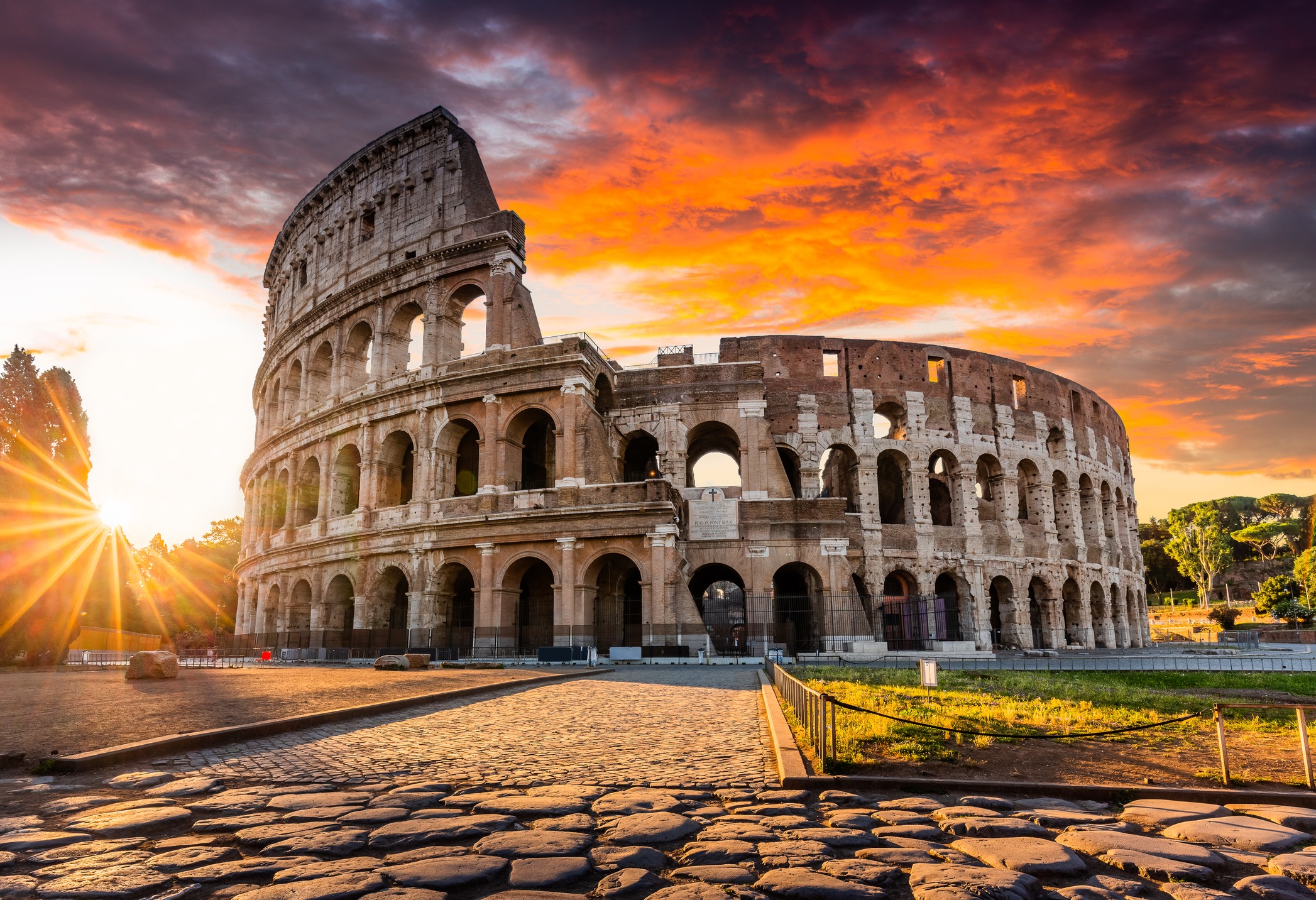
ID 144201572 ©Sorin Colac | Dreamstime.com
1. Which empire built the Colosseum in Rome?
Answer: The Roman Empire. Construction began under Emperor Vespasian and the amphitheatre opened under his son Titus in AD 80.
2. In which ancient civilization did the Olympic Games begin?
Answer: Ancient Greece. The ancient festival was held at Olympia in honour of Zeus.
3. Which Roman city was buried by the eruption of Mount Vesuvius in AD 79?
Answer: Pompeii. Herculaneum and several smaller settlements were also buried during the eruption.
4. Which Roman leader was assassinated on the Ides of March in 44 BC?
Answer: Julius Caesar. His murder accelerated the political crisis that ended the Roman Republic.
5. Which French heroine helped lead troops during the Hundred Years’ War?
Answer: Joan of Arc. She was still a teenager when she became involved in the French campaign.
6. Which English king is famous for having six wives?
Answer: Henry VIII. His effort to end his marriage to Catherine of Aragon helped drive England’s break with Rome.
7. What name is given to the cultural movement that began in Italy and revived interest in classical art and learning?
Answer: The Renaissance. It transformed European art, scholarship, architecture, and political thought.
8. Which invention associated with Johannes Gutenberg transformed the spread of books in 15th-century Europe?
Answer: The movable-type printing press. Printing existed earlier in Asia, while Gutenberg’s system changed book production in Europe.
9. What 16th-century religious movement challenged the authority of the Roman Catholic Church in much of Europe?
Answer: The Protestant Reformation. It produced new churches, political conflicts, and lasting changes in European society.
10. Which French monarch was known as the Sun King?
Answer: Louis XIV. His long reign became closely associated with royal absolutism and the Palace of Versailles.
11. Which revolution began in France in 1789 and ended the old royal order?
Answer: The French Revolution. Its ideas about citizenship, rights, and political power spread far beyond France.
12. Which French military leader crowned himself Emperor of the French in 1804?
Answer: Napoleon Bonaparte. He placed the crown on his own head during the ceremony at Notre-Dame in Paris.
13. In which European country did the Industrial Revolution begin?
Answer: Great Britain. Coal, capital, machinery, trade, and expanding transport networks all contributed to its early lead.
14. Which British queen gave her name to the era from 1837 to 1901?
Answer: Queen Victoria. Her reign coincided with industrial growth, imperial expansion, and enormous social change.
15. Whose assassination in Sarajevo in 1914 helped trigger World War I?
Answer: Archduke Franz Ferdinand of Austria. The assassination set off a chain of ultimatums, mobilizations, and declarations of war.
16. Which country did Nazi Germany invade on September 1, 1939, beginning World War II in Europe?
Answer: Poland. Britain and France declared war on Germany two days later.
17. On which part of the French coast did Allied forces land on D-Day?
Answer: Normandy. The landings on June 6, 1944 opened a major western front against Nazi Germany.
18. Which European capital was divided into eastern and western sectors during the Cold War?
Answer: Berlin. The city remained divided even though it lay inside Soviet-occupied East Germany.
19. In what year did the Berlin Wall fall?
Answer: 1989. East Germany opened the crossings on November 9 after weeks of protests and mounting political pressure.
20. In what year did euro banknotes and coins enter everyday circulation?
Answer: 2002. The euro had already been introduced for electronic payments and accounting in 1999.
Twenty completed. The next round is still accessible, although the answers won’t always be the first names or events that come to mind.
Easy European History Trivia Questions
The next 40 questions move beyond the warm-up without becoming a specialist exam. These European history general knowledge questions travel from the ancient Mediterranean to the Cold War, with recognizable people and events in every group.
Ancient Greece and Rome Trivia
We begin this easy round with ancient Greece and Rome trivia that covers government, religion, engineering, rulers, and famous cities. Roman history also explains why so many Latin phrases still used today appear in law, medicine, education, mottos, and everyday English.
21. Which Greek city-state is most closely associated with the development of democracy?
Answer: Athens. Its democracy was limited to male citizens and excluded women, enslaved people, and foreigners.
22. Which Greek city-state became famous for its military society?
Answer: Sparta. Spartan citizens underwent a demanding state-directed system of education and military training.
23. Which philosopher tutored Alexander the Great?
Answer: Aristotle. He taught the young Macedonian prince before Alexander began his conquests.
24. The Parthenon in Athens was dedicated to which goddess?
Answer: Athena. The temple stood at the centre of the city’s sacred Acropolis complex.
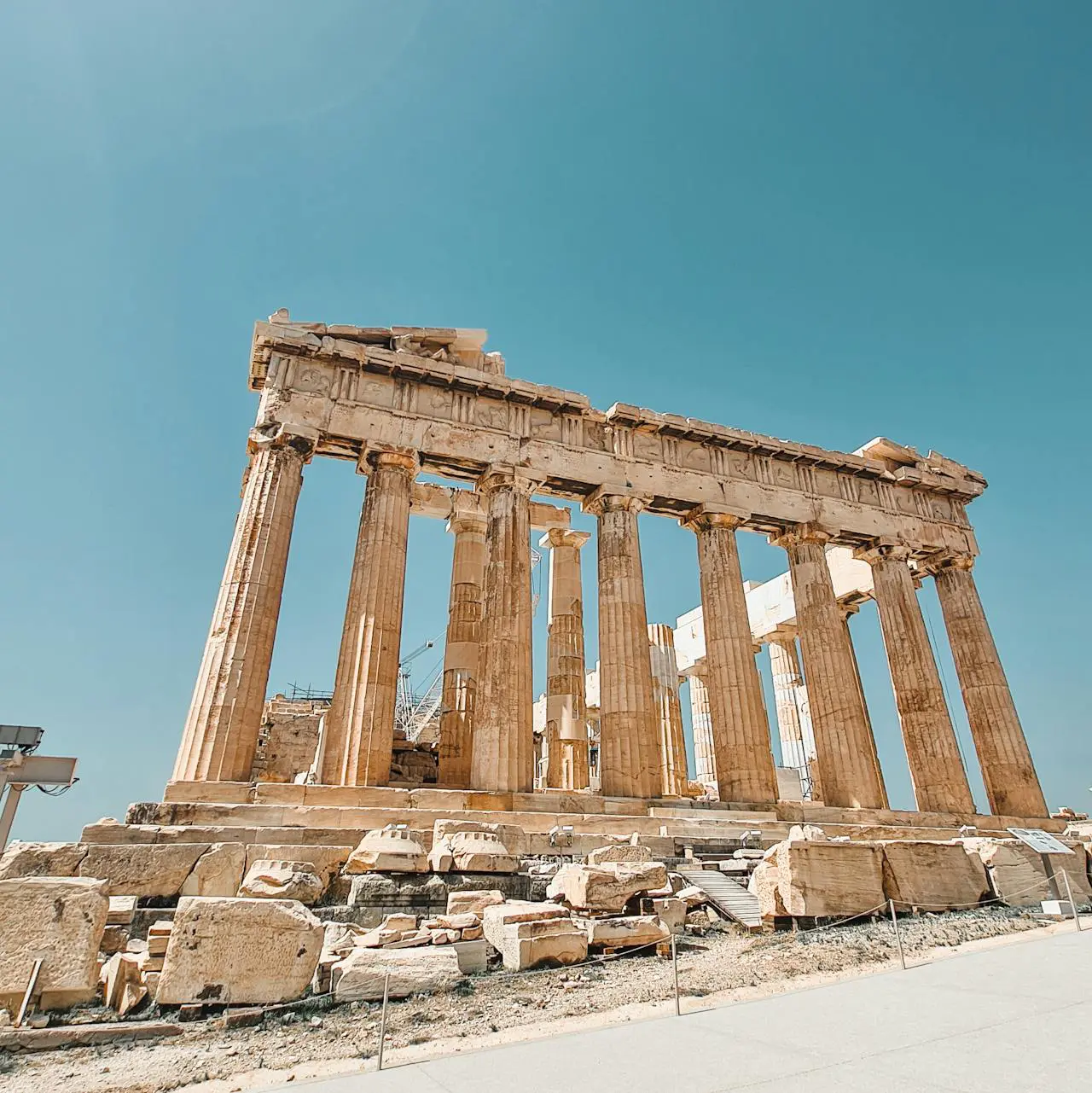 The Parthenon in Athens
25. What powerful governing body advised magistrates and shaped policy in the Roman Republic?
Answer: The Senate. Its formal powers changed over time, yet it remained one of Rome’s central political institutions.
26. Who is generally considered the first Roman emperor?
Answer: Augustus. Born Octavian, he emerged as Rome’s sole ruler after defeating Mark Antony and Cleopatra.
27. What structures carried fresh water over long distances into Roman towns and cities?
Answer: Aqueducts. Roman engineers used carefully calculated gradients to move water largely by gravity.
28. Which Roman frontier fortification stretches across northern England?
Answer: Hadrian’s Wall. Construction began in AD 122 during the reign of Emperor Hadrian.
29. Constantinople, the eastern capital of the Roman Empire, is known by what name today?
Answer: Istanbul. Constantine I inaugurated the city as his imperial capital in AD 330.
30. Which year is traditionally used to mark the fall of the Western Roman Empire?
Answer: AD 476. That was the year the Germanic commander Odoacer deposed the young emperor Romulus Augustulus.
Medieval Europe and Viking History
From Viking voyages to Magna Carta and the fall of Constantinople, these medieval Europe trivia questions stay approachable while widening the map beyond one kingdom. The period includes trade, religion, conquest, law, migration, and political systems that varied enormously across the continent.
31. Which Frankish ruler was crowned emperor by Pope Leo III on Christmas Day in AD 800?
Answer: Charlemagne. His empire covered much of western and central Europe.
32. The Vikings came primarily from which northern European region?
Answer: Scandinavia. Viking-age raiders, traders, settlers, and explorers came mainly from present-day Denmark, Norway, and Sweden.
33. Which Norse explorer is believed to have reached North America around the year 1000?
Answer: Leif Erikson. The Norse site at L’Anse aux Meadows in Newfoundland confirms a pre-Columbian European presence in North America.
34. Who won the Battle of Hastings in 1066 and became king of England?
Answer: William the Conqueror. The Norman victory reshaped England’s ruling elite, landholding, architecture, and language.
35. Which English king sealed Magna Carta in 1215?
Answer: King John. The charter was issued at Runnymede during a conflict with rebellious barons.
36. What name is commonly given to the devastating plague pandemic that struck Europe in the 14th century?
Answer: The Black Death. It killed an enormous share of Europe’s population and transformed labour, society, and religious life.
37. Which city was the main religious objective of the First Crusade?
Answer: Jerusalem. Crusader forces captured the city in 1099 and established states in the eastern Mediterranean.
38. Which two kingdoms fought the Hundred Years’ War?
Answer: England and France. The conflict lasted from 1337 to 1453, with long pauses between major campaigns.
39. Which empire captured Constantinople in 1453?
Answer: The Ottoman Empire. Sultan Mehmed II’s victory ended the Byzantine Empire.
40. What term is commonly used for the medieval system of landholding and obligations between lords and vassals?
Answer: Feudalism. Historians debate how broadly the term should be applied because medieval arrangements varied across Europe.
European Learning, Renaissance, Reformation, and Monarchs
The next Renaissance trivia questions and answers move through European learning, art, religion, and royal power, while the European monarchs trivia introduces courts and dynasties that shaped several countries. Readers who enjoy the country-specific details can continue later with the larger collection of Italy trivia questions covering Rome, art, geography, food, and history.
41. Which Italian city is widely regarded as a cradle of the Renaissance?
Answer: Florence. Wealthy patrons, workshops, humanist scholars, and political competition helped its cultural life flourish.
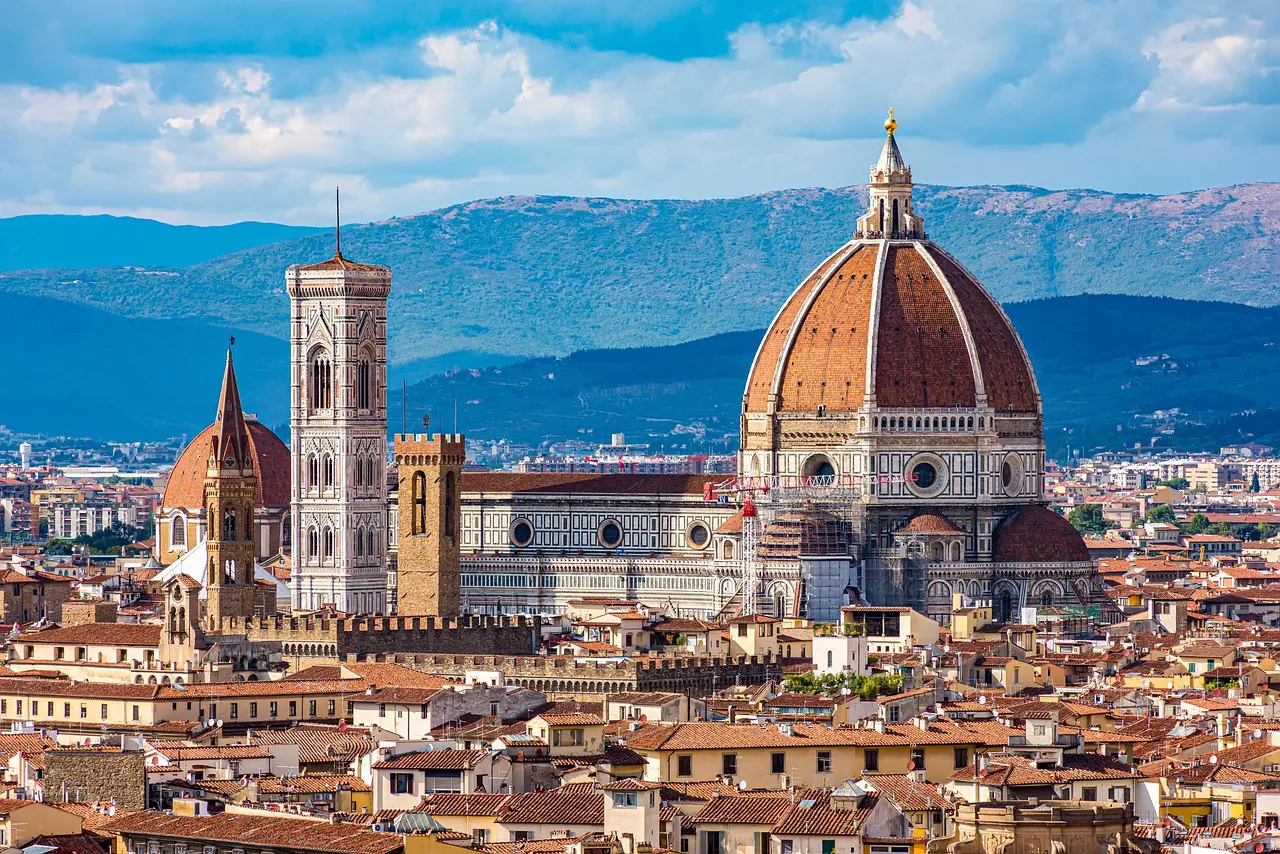 Florence, Italy
42. Which banking family became the dominant political and cultural patrons of Renaissance Florence?
Answer: The Medici family. Members of the dynasty also became popes and rulers of Tuscany.
43. Which university, traditionally dated to 1088, is considered the oldest university in the Western world?
Answer: The University of Bologna. Its exact beginnings are difficult to date, but 1088 is traditionally used as its founding year.
44. Which Renaissance polymath painted The Last Supper and filled notebooks with designs for machines?
Answer: Leonardo da Vinci. His work crossed painting, anatomy, engineering, architecture, and scientific observation.
45. Who painted the ceiling of the Sistine Chapel?
Answer: Michelangelo. He completed the vast fresco cycle between 1508 and 1512.
46. Which reformer is traditionally associated with posting the Ninety-five Theses in 1517?
Answer: Martin Luther. His challenge to indulgences became an early turning point in the Protestant Reformation.
47. Which 14th-century English theologian gave his name to a group of Middle English Bible translations?
Answer: John Wycliffe. The Wycliffite Bibles were produced by people associated with his reform movement during the late 14th century.
48. Which English queen ruled when the Spanish Armada was defeated in 1588?
Answer: Elizabeth I. The failed invasion became one of the most famous events of her reign and one of the best-known episodes in Spanish history.
49. What title was held by the elected head of the Republic of Venice?
Answer: The Doge. Doges were elected for life, although councils and laws placed considerable limits on their authority. The Doge’s Palace in Venice served as the ruler’s residence and the centre of the republic’s government.
50. Which Russian ruler founded St. Petersburg in 1703?
Answer: Peter the Great. The new city became Russia’s capital in 1712 and strengthened the country’s connection with northern Europe.
Revolutions and Modern European History
By this point, the easy round reaches European revolution trivia, industrialization, nationalism, communism, and modern European history trivia about states being created, divided, and reunited. The Congress of Vienna also left a visible imperial legacy across many of today’s Vienna landmarks.
51. Which Paris fortress-prison was stormed on July 14, 1789?
Answer: The Bastille. The event became one of the defining symbols of the French Revolution.
52. Which Austrian-born queen of France was executed during the French Revolution?
Answer: Marie Antoinette. She was the wife of Louis XVI and became a powerful symbol in revolutionary propaganda.
53. Which 1814–1815 diplomatic gathering redrew Europe after Napoleon’s defeat?
Answer: The Congress of Vienna. Representatives sought a new balance of power after more than two decades of war.
54. Which soldier and nationalist became famous for leading the Red Shirts during Italian unification?
Answer: Giuseppe Garibaldi. His Expedition of the Thousand helped bring Sicily and Naples into the emerging Italian kingdom.
55. Which Prussian statesman is most closely associated with German unification?
Answer: Otto von Bismarck. He used diplomacy and war to unite most German states under Prussian leadership.
56. Which Scottish inventor greatly improved the efficiency of the steam engine?
Answer: James Watt. His improvements helped make steam power far more useful for industry and transport.
57. Who wrote The Communist Manifesto with Friedrich Engels?
Answer: Karl Marx. The pamphlet was published in 1848 as revolutionary movements spread across Europe.
58. Which Russian dynasty was overthrown during the revolutions of 1917?
Answer: The Romanov dynasty. Tsar Nicholas II abdicated during the February Revolution.
59. Which treaty imposed the main peace terms on Germany after World War I?
Answer: The Treaty of Versailles. It was signed in 1919 and became the most famous of the postwar settlements.
60. In what year were East and West Germany formally reunified?
Answer: 1990. German reunification took effect on October 3.
If you answered most of these correctly, your general knowledge is already strong. The next round moves into the stranger corners of Europe’s past.
Surprising European History Trivia Questions
History becomes easier to remember when an answer overturns a familiar image or reveals an unexpected detail. This round blends surprising European history facts, strange European history trivia, and a few European history myths and facts that have been repeated for generations. A few could even qualify as funny facts about European history, although most are better described as odd, unexpected, or ironic.
61. Did Viking warriors routinely wear horned helmets in battle?
Answer: No. The familiar image comes largely from later art, costume design, and popular culture rather than Viking-age evidence.
62. Did educated medieval Europeans generally believe the Earth was flat?
Answer: No. Learned Europeans inherited the ancient Greek understanding that Earth was spherical, although knowledge varied across society.
63. Was Napoleon exceptionally short for a man of his time?
Answer: No. He was around average height for a Frenchman of his period, and confusion between French and British measurements helped the myth grow.
64. Which French inventor developed a successful method of preserving food after the French government offered a reward?
Answer: Nicolas Appert. He preserved food in sealed glass containers, helping lay the foundations of modern canning and becoming one of the most practical invention facts about France.
65. What unusual act gave several Bohemian political crises the name “defenestrations of Prague”?
Answer: People were thrown from windows. The 1618 defenestration helped ignite the Thirty Years’ War.
66. Which European city experienced the famous Dancing Plague of 1518?
Answer: Strasbourg. Contemporary accounts describe people dancing for days, although historians still debate the causes.
67. What flower became the centre of a speculative craze in the Dutch Republic during the 1630s?
Answer: The tulip. Prices for some rare bulbs rose dramatically before the market collapsed.
68. Which deceased pope’s body was put on trial during the Cadaver Synod?
Answer: Pope Formosus. His corpse was exhumed and tried in Rome in 897 during a bitter struggle for papal power.
69. What name was given to the unbearable smell from the River Thames that overwhelmed London in 1858?
Answer: The Great Stink. The crisis increased pressure for a modern sewer system designed under Joseph Bazalgette.
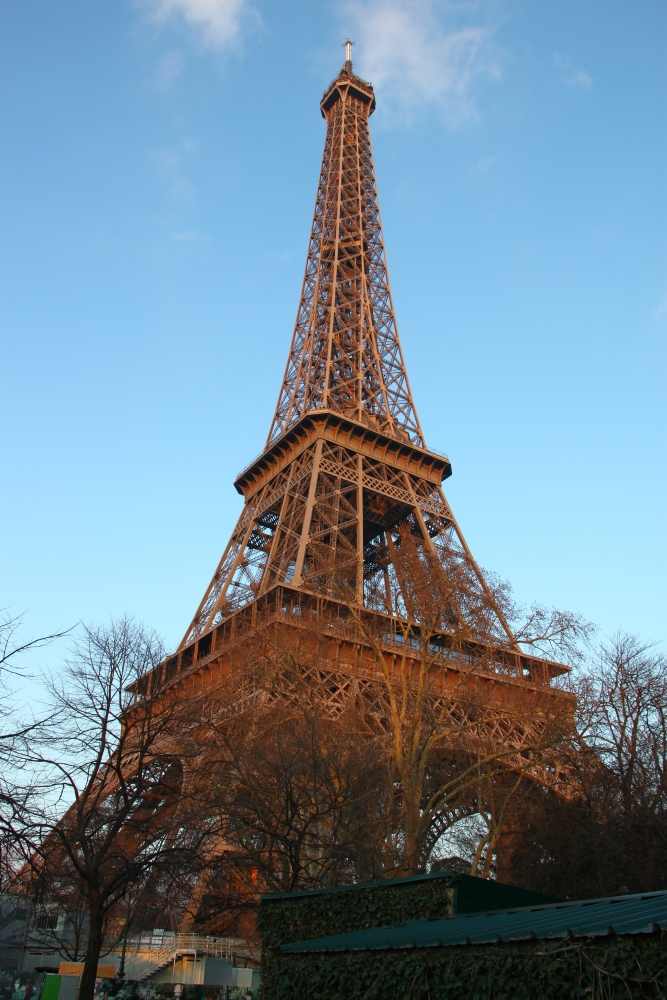
70. Which Paris landmark was originally permitted to stand for only 20 years?
Answer: The Eiffel Tower. Its usefulness for scientific experiments and radio communication helped secure the survival of one of the best-known landmarks in Paris.
71. What changed on Sweden’s “Dagen H” in 1967?
Answer: Traffic switched from driving on the left to driving on the right. The nationwide change took place on September 3.
72. Which country elected Vigdís Finnbogadóttir as the world’s first democratically elected female president in 1980?
Answer: Iceland. She served four terms and remained president until 1996.
73. How many days were in a standard week under the French Revolutionary calendar?
Answer: Ten days. The new calendar divided months into three ten-day periods called décades.
74. Which modern Bulgarian city was known as Philippopolis after Philip II of Macedon?
Answer: Plovdiv. The city has carried several names during its long history under Thracian, Macedonian, Roman, Byzantine, Ottoman, and Bulgarian rule. The city’s Roman theatre and layered old town are central to a visit to Plovdiv today.
75. What personal feature did Peter the Great tax as part of his campaign to encourage Western European styles?
Answer: Beards. Men who paid the tax could receive a token showing that the charge had been paid.
The unusual round is over. From here, the quiz begins testing connections between events, rulers, borders, and ideas.
Medium European History Trivia Questions
The middle of this European history quiz requires more than recognizing the most famous name. Borders shift, states combine and disappear, and the links between political history and geography trivia questions become much clearer.
Empires, Kingdoms, and Changing Borders
These questions move through Byzantium, eastern Europe, Scandinavia, Iberia, the Ottoman Empire, and the Habsburg lands. They are useful European history questions for students, adults, and quiz hosts who want broader coverage than the usual sequence of British monarchs and the two world wars.
76. Which Byzantine emperor ordered the compilation now known as the Corpus Juris Civilis?
Answer: Justinian I. The legal collection influenced later civil-law traditions across Europe.
77. What 1054 rupture divided the western and eastern branches of Christianity?
Answer: The Great Schism. It is conventionally associated with the split between the Roman Catholic and Eastern Orthodox churches.
78. Which city was the political and cultural centre of Kievan Rus’?
Answer: Kyiv. The medieval polity connected eastern Europe with Byzantium, Scandinavia, and the steppe.
79. Which 1569 agreement created the Polish-Lithuanian Commonwealth?
Answer: The Union of Lublin. It formed one of early modern Europe’s largest and most distinctive states.
80. Which three kingdoms were joined under the Kalmar Union in 1397?
Answer: Denmark, Norway, and Sweden. The union placed the Scandinavian crowns under one monarch, though internal conflict continued.
81. The fall of which Muslim-ruled kingdom in 1492 completed the Christian conquest of Iberia?
Answer: Granada. Its surrender to Ferdinand of Aragon and Isabella of Castile ended the Nasrid kingdom.
82. Which empire ruled much of southeastern Europe and twice besieged Vienna?
Answer: The Ottoman Empire. The major Ottoman sieges of Vienna took place in 1529 and 1683.
83. Which ruler governed Spain as Charles I and the Holy Roman Empire as Charles V?
Answer: Charles of Habsburg. His territories stretched across Europe and the Americas, though they weren’t a single centralized state.
84. Which Bavarian dynasty ruled for more than seven centuries and used the Munich Residenz as its principal palace?
Answer: The Wittelsbach dynasty. Its long rule shaped Bavaria’s political, architectural, and cultural history. The dynasty’s former home can still be explored through the rooms and collections of the Munich Residenz.
85. What 1867 settlement created the Dual Monarchy of Austria-Hungary?
Answer: The Austro-Hungarian Compromise, also called the Ausgleich. It gave Hungary broad internal autonomy under the Habsburg monarch. The settlement helps explain the imperial architecture and political history visible across Buda and Pest.
Treaties, Revolutions, and National Movements
ID 21798989 ©Photowitch | Dreamstime.com
The difficulty rises in this set of European history quiz questions and answers. Treaties and congresses can look like a wall of dates, so the questions focus on what each settlement changed, ended, or attempted to preserve.
86. Which 1648 peace settlement ended the Thirty Years’ War?
Answer: The Peace of Westphalia. The settlement consisted of treaties negotiated at Münster and Osnabrück.
87. Which English king was executed after defeat in the English Civil Wars?
Answer: Charles I. He was tried and beheaded in 1649, after which England became a republic for more than a decade.
88. Which monarchs replaced James II during the Glorious Revolution?
Answer: William III and Mary II. Their accession strengthened Parliament’s position within the English constitutional system.
89. Which Enlightenment thinker argued for the separation of legislative, executive, and judicial powers?
Answer: Montesquieu. His ideas influenced later constitutions in Europe and beyond.
90. The Greek War of Independence was fought against which empire?
Answer: The Ottoman Empire. The struggle began in 1821 and led to international recognition of an independent Greek state.
91. What was the name of the unsuccessful 1825 uprising by Russian army officers who opposed Nicholas I?
Answer: The Decembrist Revolt. Its leaders demanded political reform, although their aims weren’t identical.
92. What phrase is often used for the wave of European revolutions that began in 1848?
Answer: The Springtime of Nations. Revolts and reform movements spread across France, the German states, the Habsburg lands, Italy, and elsewhere.
93. Which war pitted Russia against an alliance including the Ottoman Empire, Britain, France, and Sardinia?
Answer: The Crimean War. Most of the major fighting took place on the Crimean Peninsula between 1853 and 1856.
94. Which 1878 congress revised the Treaty of San Stefano and reshaped the Balkans?
Answer: The Congress of Berlin. The decisions altered borders and the international status of several Balkan territories.
95. What revolutionary government briefly ruled Paris in 1871?
Answer: The Paris Commune. It lasted a little over two months before being crushed by French government forces.
World Wars, the Cold War, and European Integration
These World War I European history questions lead into interwar Europe, World War II European history trivia, resistance, the Cold War, and the movements that weakened communist governments. The questions stay factual and concise, with the broader consequences explained where they help.
96. Which three powers formed the core of the Triple Entente before World War I?
Answer: France, Russia, and Britain. The arrangement developed through separate agreements rather than one single alliance treaty.
97. Which treaty, signed in 1992 and effective from 1993, formally established the European Union?
Answer: The Maastricht Treaty. It also introduced European Union citizenship and laid foundations for the future single currency.
98. Which treaty took Russia out of World War I in 1918?
Answer: The Treaty of Brest-Litovsk. Bolshevik Russia accepted severe territorial losses to the Central Powers.
99. Which post-World War I treaty redrew Hungary’s borders?
Answer: The Treaty of Trianon. Signed in 1920, it left large Hungarian-speaking populations outside the new frontiers.
100. Which general led the Nationalist side to victory in the Spanish Civil War?
Answer: Francisco Franco. He then ruled Spain as a dictator until his death in 1975.
101. What 1939 agreement included a secret protocol dividing parts of eastern Europe into German and Soviet spheres?
Answer: The Molotov-Ribbentrop Pact. Germany invaded Poland days later, and the Soviet Union invaded from the east on September 17.
102. What 1944 uprising sought to liberate Poland’s capital from German occupation before the Soviet army arrived?
Answer: The Warsaw Uprising. The Polish Home Army fought for 63 days before the revolt was defeated.
103. What operation supplied West Berlin during the Soviet blockade of 1948–1949?
Answer: The Berlin Airlift. Western aircraft delivered food, fuel, and other necessities to the city.
104. What name was commonly used for East Germany’s Ministry for State Security?
Answer: The Stasi. It operated as a domestic secret police organization, an investigative authority, and a foreign intelligence agency in the German Democratic Republic.
105. Which independent trade union movement emerged in Poland in 1980 under Lech Wałęsa?
Answer: Solidarity. It became a major force in the eventual collapse of communist rule in Poland.
You have reached the point where broad general knowledge may no longer be enough.
Hard European History Trivia Questions
The hard European history trivia questions begin after Question 105, once readers have had plenty of chances to build a strong score. As a Romanian, this is also the point where I have to resist turning one part of the article into an entire quiz about my country. Romania’s past includes Roman roots, medieval principalities, shifting borders, monarchy, dictatorship, communism, and the 1989 Revolution.
Historic buildings preserve one part of that story, from castles in Romania to the enormous Palace of Parliament and other reminders of Romania’s communist history. Language carries another layer, which is one reason I also enjoy tracing old ideas through Romanian proverbs and sayings.
Hard Medieval and Early Modern European History
The first hard set covers religious conflicts, dynastic unions, medieval law, disputed authority, and states that don’t fit neatly inside modern borders. These questions reward readers who know more than the most famous medieval names.
106. What was Byzantine Iconoclasm primarily a dispute about?
Answer: The use and veneration of religious images. The controversy divided the Byzantine Empire during the eighth and ninth centuries.
107. Which 1071 battle saw the Byzantine emperor Romanos IV defeated by the Seljuk Turks?
Answer: The Battle of Manzikert. The defeat became an important turning point in Byzantine control of Anatolia.
108. Which 1356 decree established important rules for electing the Holy Roman emperor?
Answer: The Golden Bull of 1356. It formalized the role of seven prince-electors.
109. What name is given to the period when several popes resided at Avignon rather than Rome?
Answer: The Avignon Papacy. It lasted from 1309 to 1377 and was followed by the Western Schism.
110. The Hussite movement took its name from which Bohemian religious reformer?
Answer: Jan Hus. He was executed for heresy in 1415, and his death helped spark the Hussite Wars.
111. Which 1385 agreement created a dynastic union between Poland and Lithuania?
Answer: The Union of Krewo. It connected the Polish crown with Grand Duke Jogaila of Lithuania, who became King Władysław II Jagiełło of Poland.
112. Which 1389 battle became a central event in Serbian historical memory?
Answer: The Battle of Kosovo. Ottoman and Serbian-led forces fought on Kosovo Field, and both rulers died in connection with the battle.
113. Which council ended the Western Schism and elected Pope Martin V?
Answer: The Council of Constance. Meeting from 1414 to 1418, it also condemned Jan Hus.
114. Which 1555 settlement allowed rulers in the Holy Roman Empire to choose between Catholicism and Lutheranism?
Answer: The Peace of Augsburg. Its arrangement didn’t recognize Calvinism and failed to end religious conflict permanently.
115. What 1572 massacre targeted French Protestants during the Wars of Religion?
Answer: The St. Bartholomew’s Day Massacre. Violence began in Paris and spread to other French cities.
Hard 18th- and 19th-Century European History
Royal succession, partitions, secret societies, customs unions, wars, and diplomatic settlements shape this round. Several of these stories are easier to understand when seen through surviving palaces and collections in the museums of Vienna and other former imperial capitals.
116. Which Habsburg document was designed to secure Maria Theresa’s succession?
Answer: The Pragmatic Sanction of 1713. European powers accepted it at different times, yet her accession still led to the War of the Austrian Succession.
117. Which group of treaties ended the War of the Spanish Succession?
Answer: The Treaties of Utrecht. Signed in 1713, they redistributed territories and recognized Philip V as king of Spain under stated conditions.
118. In what year did Russia, Prussia, and Austria carry out the First Partition of Poland?
Answer: 1772. Two further partitions in 1793 and 1795 removed the Polish-Lithuanian Commonwealth from the map.
119. Which major rebellion challenged Catherine the Great’s rule between 1773 and 1775?
Answer: Pugachev’s Rebellion. Yemelyan Pugachev claimed to be the deposed emperor Peter III and attracted Cossacks, peasants, and other discontented groups.
120. What was Napoleon’s trade blockade against Britain called?
Answer: The Continental System. It tried to exclude British goods from European markets but proved difficult to enforce.
121. Which conservative alliance was formed by Russia, Austria, and Prussia after the Napoleonic Wars?
Answer: The Holy Alliance. It was associated with the defence of monarchy and the post-1815 order.
122. What name was given to the secret revolutionary societies active in early 19th-century Italy?
Answer: The Carbonari. Their members supported constitutional change and played a role in movements that preceded Italian unification.
123. Which 1827 naval battle destroyed an Ottoman-Egyptian fleet and aided Greek independence?
Answer: The Battle of Navarino. British, French, and Russian fleets defeated the Ottoman-Egyptian force in the Bay of Navarino.
124. What German customs union helped integrate many German states economically before political unification?
Answer: The Zollverein. Prussia led the customs union, which reduced internal trade barriers among participating states.
125. Which 1871 treaty ended the Franco-Prussian War?
Answer: The Treaty of Frankfurt. France ceded most of Alsace and part of Lorraine to the new German Empire.
Hard 20th-Century European History
This Cold War Europe quiz section reaches beyond the Berlin Wall to diplomatic agreements, uprisings, reform movements, and political transitions across central and eastern Europe. The answers often depend on distinguishing events that happened only a few years apart.
126. Which 1922 treaty normalized relations between Germany and Soviet Russia?
Answer: The Treaty of Rapallo. Both countries renounced certain claims and restored diplomatic and economic relations.
127. Which 1925 agreements aimed to stabilize Germany’s western borders?
Answer: The Locarno Treaties. Germany, France, Belgium, Britain, and Italy were central to the agreements.
128. Which 1938 agreement allowed Nazi Germany to annex the Sudetenland from Czechoslovakia?
Answer: The Munich Agreement. Czechoslovakia wasn’t a party to the negotiations that decided the territorial concession.
129. At which site did Soviet security forces murder thousands of Polish officers and prisoners in 1940?
Answer: Katyn. The Katyn massacre also refers more broadly to executions at several locations ordered by Soviet authorities.
130. Which Romanian city saw mass protests in December 1989 that helped ignite the revolution against Nicolae Ceaușescu?
Answer: Timișoara. The unrest spread, and Ceaușescu’s regime collapsed within days.
131. Which Hungarian prime minister was executed after the failed 1956 revolution?
Answer: Imre Nagy. He had announced Hungary’s withdrawal from the Warsaw Pact during the uprising.
132. Which military alliance invaded Czechoslovakia in August 1968 to end the Prague Spring?
Answer: The Warsaw Pact. Soviet-led forces occupied the country, although Romania and Albania didn’t participate in the invasion.
133. Which 1975 agreement linked European security, borders, cooperation, and human rights?
Answer: The Helsinki Final Act. Thirty-five states signed it through the Conference on Security and Co-operation in Europe.
134. What peaceful 1989 movement ended communist rule in Czechoslovakia?
Answer: The Velvet Revolution. Václav Havel became president at the end of that year.
135. What informal name is given to the peaceful 1993 division of Czechoslovakia?
Answer: The Velvet Divorce. It produced the Czech Republic and Slovakia on January 1, 1993.
Fifteen questions remain. The final round includes chronology, former countries, historical city names, and details even strong history fans may miss.
Expert European History Trivia Challenge
The final expert European history questions change the way you have to think. Several require chronology or connections between treaties, states, cities, and political changes rather than the recall of one famous person.
136. Put these events in chronological order: the Edict of Milan, the completion of the Domesday Book, the Acts of Union that created Great Britain, and the Lisbon earthquake.
Answer: The Edict of Milan in AD 313; the Domesday Book in 1086; the Acts of Union in 1707; and the Lisbon earthquake in 1755.
137. What name was given to the series of civil conflicts that shook France during the childhood of Louis XIV?
Answer: The Fronde. The rebellions involved magistrates, nobles, royal officials, and competing political factions between 1648 and 1653.
138. Which Holy Roman emperor transferred his court to Prague in 1583 and became known for supporting artists, astronomers, and scholars?
Answer: Rudolf II. His court helped turn Prague into an important centre of European art and scientific study.
139. Which disappeared first: the Holy Roman Empire, the Russian Empire, the Ottoman Empire, or the Soviet Union?
Answer: The Holy Roman Empire. Emperor Francis II dissolved it in 1806 during the Napoleonic Wars.
140. Which Swedish queen abdicated in 1654, converted to Catholicism, and later settled in Rome?
Answer: Christina of Sweden. Her abdication, conversion, and patronage of the arts made her one of 17th-century Europe’s most unusual royal figures.
141. Which 1839 treaty recognized Belgian independence and guaranteed its neutrality?
Answer: The Treaty of London. Its guarantee of Belgian neutrality later became important in Britain’s entry into World War I.
142. Which treaty ended the Crimean War in 1856?
Answer: The Treaty of Paris. It neutralized the Black Sea under the original settlement and admitted the Ottoman Empire to the Concert of Europe.
143. Which 1920 treaty proposed a severe partition of the Ottoman Empire before being superseded by the Treaty of Lausanne?
Answer: The Treaty of Sèvres. The Turkish War of Independence prevented much of it from being implemented.
144. Which country was known from 1918 to 1929 as the Kingdom of Serbs, Croats and Slovenes?
Answer: Yugoslavia. King Alexander I changed the state’s name to the Kingdom of Yugoslavia in 1929.
145. What was the German name of the East Prussian city now called Kaliningrad?
Answer: Königsberg. The city became part of the Soviet Union after World War II and was renamed in 1946.
146. Which Romanian city was historically known as Kronstadt in German and Brassó in Hungarian?
Answer: Brașov. Its names reflect the city’s Romanian, Saxon, and Hungarian history in Transylvania. The German, Hungarian, and Romanian layers are still visible during a visit to Brașov.
147. Which 1929 agreement between Italy and the Holy See created Vatican City State?
Answer: The Lateran Treaty. It recognized Vatican City as a sovereign state and resolved the long-running dispute between the papacy and the Italian state.
148. Which Mediterranean islands, together with Tripoli, did Charles V grant to the Knights of St John in 1530 under an arrangement requiring an annual falcon as tribute?
Answer: Malta and Gozo. The grant also included Tripoli, and the falcon served as a symbolic annual acknowledgment of the arrangement.
149. In what year did Louis XIV revoke the Edict of Nantes?
Answer: 1685. The revocation ended many protections previously granted to French Protestants.
150. Which 1991 agreement signed by the leaders of Russia, Ukraine, and Belarus declared that the Soviet Union had ceased to exist?
Answer: The Belavezha Accords. The agreement also announced the creation of the Commonwealth of Independent States.
How Did You Score?
Reaching the end of 150 questions already says something about your patience and curiosity. Compare your result below, then decide which historical period helped or hurt your score most.
0–40 correct: You completed a journey through more than two thousand years of European history.
41–75 correct: You have strong European history foundations.
76–105 correct: Your general knowledge is impressive.
106–130 correct: You are a serious history enthusiast.
131–145 correct: You belong in the European history expert tier.
146–150 correct: Your score is almost impossible to beat.
Which question finally stumped you? You can also compare this result with a wider set of general knowledge questions and answers that includes science, geography, culture, entertainment, and other topics.
How to Use These European History Questions
For a family game, begin with the warm-up and easy rounds, then stop when the questions become too specialized for the group. A classroom activity can focus on one historical period or use questions from several levels to see where students need more revision.
For European history pub quiz questions, choose five warm-up questions, ten medium questions, five hard questions, and one or two expert tiebreakers. Read the short explanation only after teams have submitted their answers so it becomes a useful fact rather than an accidental clue.
This collection also works as European history trivia for adults, teens, teachers, and mixed-age teams. If your group prefers visual clues, a guess-the-country landmark quiz can make a lighter companion round.
How These European History Questions Were Checked
Dates, rulers, treaties, institutions, borders, and historical names were checked against reputable historical references and official institutional material. Ambiguous wording was rewritten, and alternative names are included where readers could reasonably give more than one form of the answer.
Claims involving “first,” “oldest,” or “largest” were kept out unless the criterion could be stated clearly. Myths are labelled as myths, modern borders aren’t projected carelessly onto medieval states, and events involving disputed terminology are explained briefly rather than squeezed into a misleading one-word answer.
Useful reference points included the cultural collections available through Europeana, the official history of the European Union, and the historical collections and articles published by the Imperial War Museums.
Conclusion
European history stretches across ancient civilizations, religious change, dynasties, inventions, revolutions, empires, wars, political experiments, and borders that moved repeatedly. A score can show which facts you remember, while the short explanations reveal how often one event connects with several countries.
For another way to explore the past through what survives today, you can visit European art museums online or return to travel trivia and see how historical knowledge changes the way familiar cities and landmarks look.
Frequently Asked Questions About European History Trivia
How difficult is this European history quiz?
The quiz begins with 20 confidence-building questions, continues through easy and surprising rounds, becomes more demanding in the medium section, and saves the hardest chronology, treaty, border, and former-country questions for the end.
What historical periods are included?
The questions cover ancient Greece and Rome, the Middle Ages, the Renaissance and Reformation, European monarchies, revolutions, industrialization, nationalism, the world wars, the Cold War, the fall of communist governments, and modern European integration.
Can I use these questions for a pub quiz or classroom?
Yes. Select questions from several difficulty levels, keep the expert round for tiebreakers, and read the context notes after the answers have been collected. Teachers can also choose one period at a time for review.
Are the answers fact-checked?
Yes. Dates, names, treaties, borders, and institutions were checked, while questions with potentially ambiguous answers were rewritten or given a clarifying note.
Are these European history questions suitable for children?
The warm-up and many easy questions can work for older children and teens. The hard and expert rounds are better suited to adults, advanced students, and readers with a strong interest in history.
More amazing articles for you:

Violeta-Loredana Pascal is a communications expert, business mentor, and the founder of Earth’s Attractions and PRwave INTERNATIONAL. A pioneer in the Romanian digital PR landscape since 2005, she holds a degree in Communication and Social Sciences from SNSPA Bucharest. Violeta is a senior trainer at AcademiadeAfaceri.ro, where she leverages over 20 years of experience to teach professional courses in PR strategy and workplace productivity. By blending high-level business consulting with a passion for holistic travel and wellness, she empowers solopreneurs to overcome procrastination, build profitable brands, and design a life of purposeful adventure.
