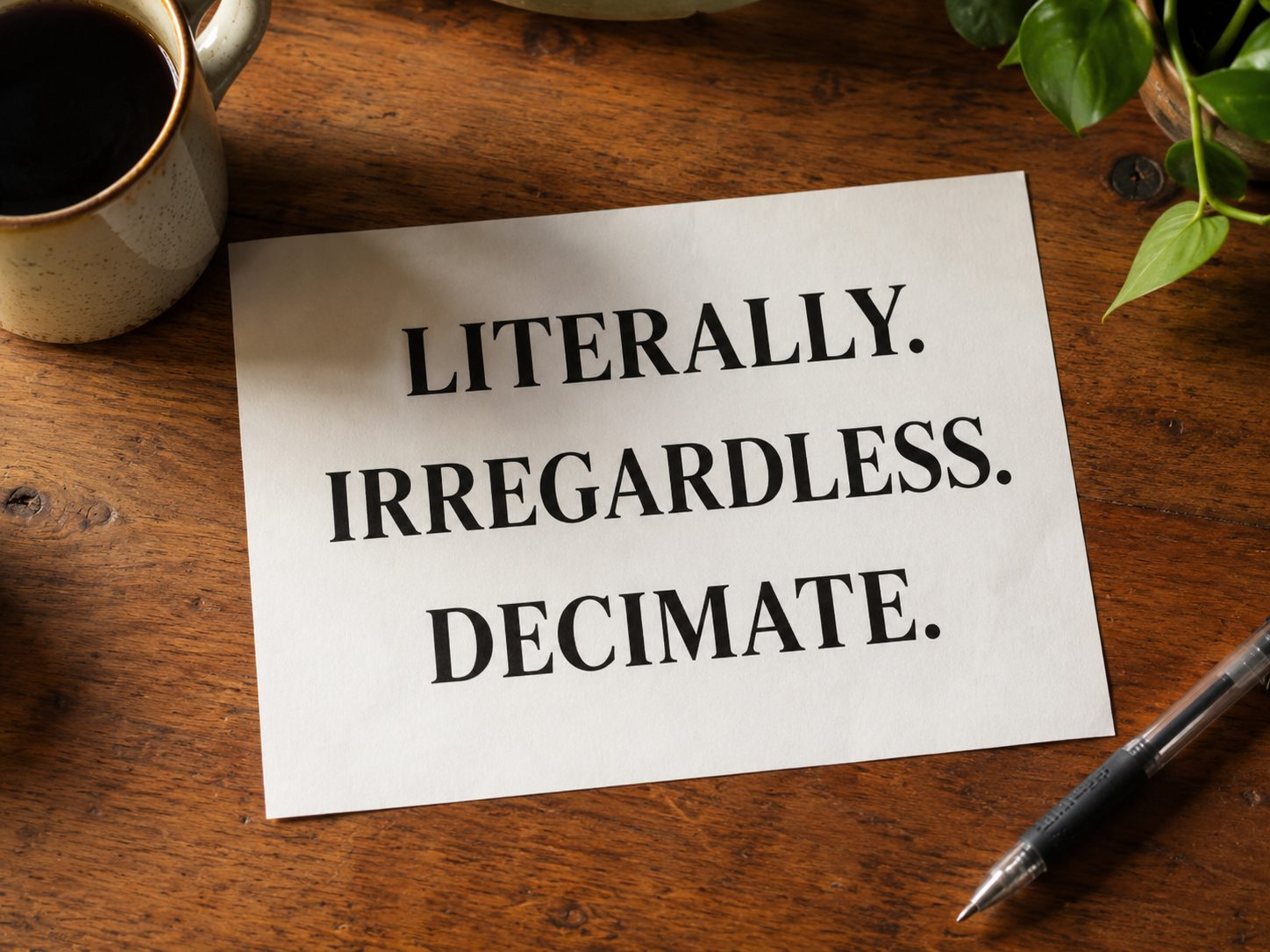
40 Words You’ve Probably Been Using Wrong – And Some You’ve Been Correcting for No Reason
This post may contain affiliate links. If you click on one and make a purchase, I might earn a small commission (at zero extra cost to you), which helps me keep this blog running.
I have always paid attention to language. I spent all four years of high school in a philology class, studied Latin throughout, and I am Romanian, so English words often sit beside related words from other languages in my mind even though I think in English a lot of the time. But we can pick up a word and attach it a meaning we discovered when seeing that word used in a TV show or in a conversation, only to discover later that the meaning we attached to it was incomplete, outdated, or completely different.
I have also spent my professional life working in communication (21+ years). While preparing my collection of Latin phrases still used today, I was reminded of how often old words survive while their everyday use shifts around them. Even familiar names can hide meanings we no longer notice, as I found when researching what famous landmark names actually mean.
The interesting part isn’t only discovering that a familiar word has been used in the wrong way. Several words on this list are still being “corrected” according to rules that current dictionaries no longer treat as absolute. That changes the question from “Is this wrong?” to “Will readers understand it the way I intend?”
The 40 entries below focus on words people meet in ordinary conversations, reports, articles, meetings, and books. Each explanation includes enough context to help you use the word with confidence without turning the article into a grammar lecture. And the last 12 might surprise you 😀
Would You Correct Any of These Sentences?
Before reading the full list of commonly misunderstood words, look at these four sentences. Each contains a word that appears regularly in discussions about words people use incorrectly.
1. I was ambivalent about leaving a job I loved.
2. She perused the menu and ordered within a minute.
3. The disease decimated the local population.
4. The judge remained disinterested throughout the case.
Would you change any of them? Keep your answers in mind. I will return to all four sentences near the end, after the distinctions have had a chance to become clear.
When a “Wrong” Meaning Is No Longer Wrong
Lists of words people correct incorrectly often treat language as though every word received one permanent definition centuries ago. In reality, words whose meanings have changed can keep their older senses, gain new ones, become more informal, or develop different uses in different countries.
That regional element is easy to notice in British sayings that confuse travelers. A familiar English word may carry a different tone or implication in the UK than it does in the United States. The same caution applies to several words in this article.
For every entry, I checked current definitions and usage notes rather than relying on old “you have been saying this wrong” lists. The main references were Merriam-Webster, the Cambridge Dictionary, and Oxford Learner’s Dictionaries. The article was reviewed in July 2026.
Familiar Words That Can Completely Change How a Person Sounds
Many words people use incorrectly in conversation describe feelings, reactions, and personality. These words with unexpected meanings can make someone sound detached when they are conflicted, calm when they are confused, or amused when they are actually lost.
Cultural expressions can create similar surprises. I found many examples while exploring Japanese proverbs and sayings: a short phrase may look simple in translation while carrying a much more precise idea. Everyday English deserves the same attention, especially since small wording choices can become communication mistakes we make without noticing.
1. Ambivalent
You may hear this used for indecision, indifference, or a general lack of enthusiasm. The word becomes more precise when two genuine reactions are pulling in different directions.
Ambivalence involves conflicting feelings about the same person, choice, or situation. You might feel ambivalent about accepting a promotion because the salary is attractive while the longer hours would reduce your family time. When neither option matters, indifferent is clearer. When you haven’t reached a decision, undecided may fit better.
2. Incredulous
This word often lands on the surprising story, excuse, or claim itself. The more revealing place to look is the person reacting to it.
An incredulous person is unwilling or unable to believe something. “She gave him an incredulous look after hearing the excuse” works because the reaction belongs to her. The excuse itself may be incredible, implausible, or unbelievable.
3. Enervated
At first glance, this looks like a stronger, more formal relative of energized. Using it that way would reverse the sentence.
To enervate someone is to weaken them or drain their energy. After a sleepless night and a delayed flight, you may feel enervated. The renewed feeling after rest, coffee, or good news would be energized, revived, or invigorated.
For me, this word is funny because in Romanian, a enerva means to annoy :D, and enervat means annoyed.
4. Complacent
It is easy to hear calmness or contentment in this word. Yet it usually points to a comfortable state that has gone far enough to hide a problem.
Complacency combines self-satisfaction with too little awareness of danger, weakness, or a need to improve. A company may become complacent after several successful years and fail to notice customers leaving. A driver may become complacent on a familiar road and stop paying close attention. For a peaceful state without that warning, use content, comfortable, or at ease.
5. Nonplussed
This is one of the few common words that can send two people toward opposite pictures of the same person. Regional usage is a large part of the confusion.
Traditionally, a nonplussed person is perplexed and unsure how to respond. In American English, the word is also widely used for someone unfazed or unimpressed. Both senses appear in current dictionaries, so confused, stunned, unfazed, or unimpressed may be safer when the reaction needs to be unmistakable.
6. Bemused
Because it resembles amused, this word is often attached to a small smile or mild entertainment. Its range is less cheerful and more complicated.
A bemused person may be confused, bewildered, lost in thought, or showing wry amusement at something puzzling. Imagine someone facing a machine with too many buttons and no instructions: the expression may combine confusion with a small, disbelieving smile. Use bewildered when confusion is the whole point.
7. Reticent
Many people use this whenever someone hesitates to do something. Older usage tied it much more closely to what a person was willing to say.
The traditional sense describes someone reserved or unwilling to speak freely: reticent about discussing money, family, or a difficult experience. The broader sense of reluctant is also well established, so someone can be reticent to sign a contract or attend an event. Reluctant is still clearer when speech or disclosure isn’t involved.
8. Disinterested
This word can make a judge sound admirably neutral or a student sound bored. The sentence around it has to do more work than many writers realize.
A disinterested judge has no personal stake in the outcome, while a disinterested student may simply have stopped paying attention. Dictionaries record both the impartial and lack-of-interest senses. Use impartial when neutrality matters and uninterested when someone is bored. Clear emotional wording also helps in moments when “I’m fine” closes a conversation you hoped to continue.
Words That Can Change the Meaning of a Meeting, Report, or Argument
Professional conversations contain plenty of commonly misused words at work. A few smart-sounding words used incorrectly can make a report less precise, make a claim sound stronger than the evidence allows, or create an argument nobody intended to start.
Word choice also affects credibility. People may focus on a vague or inflated term instead of the point you were making, much as certain speech habits can influence whether people take you seriously. Automatic business wording creates a similar problem, which is one reason phrases such as “just checking in” often need a clearer replacement.
9. Refute
People often use this after any firm denial, rebuttal, or public disagreement. The word makes a stronger claim about what the response has achieved.
The strongest sense of refute is to show that a claim is false through argument or evidence. Current dictionaries also record a looser sense: to deny or contradict a claim. That means a headline saying someone “refuted the allegations” may tell us only that they rejected them. When evidence has actually proved the claim false, refute is exact. Otherwise, denied, challenged, or disputed tells readers more clearly what happened.
10. Rebuttal
A rebuttal answers a claim with an opposing argument or evidence. A company that publishes a detailed response has offered a rebuttal, but readers may still find it weak. The word records the answer; it doesn’t award victory.
To rebut is to answer a claim with opposing argument or evidence. A company that publishes a detailed response has rebutted the criticism, but readers may still find the response weak. The word records the answer; it doesn’t award victory.
11. Infer
These next two words are often swapped because they describe the same exchange from opposite sides. With infer, attention belongs on the person receiving the clues.
To infer is to reach a conclusion from what you see, hear, or already know. When a manager looks at the clock and says, “We have an early start tomorrow,” you may infer that the meeting should end. The listener, reader, or observer does the inferring.
12. Imply
The other half of that exchange starts with the speaker or writer. Meaning is placed between the lines for someone else to pick up.
To imply is to suggest a meaning without stating it directly. In that same meeting, the manager implies that it is time to finish; everyone else infers the message and starts gathering their things. The speaker or writer implies, and the audience infers.
13. Mitigate
This word is popular in plans, policies, and risk discussions, where it can sound more decisive than it really is. The problem may still be present afterward.
Mitigation lowers severity, risk, damage, or an unpleasant effect. Travel insurance may mitigate financial loss, better drainage may mitigate flood damage, and an apology may mitigate the consequences of a mistake. When the problem has ended, choose eliminated, prevented, resolved, or removed.
14. Exacerbate
It is often confused with a similar word about irritation, and the two may even appear in the same frustrating situation. One concerns the problem; the other concerns the person.
To exacerbate something is to make it more severe. Delays can exacerbate a staffing problem, heat can exacerbate symptoms, and unclear instructions can exacerbate confusion. Exasperate concerns irritation: a complicated form may exasperate you, while a missing page exacerbates the difficulty of completing it.
15. Viable
In meetings, calling an idea viable can sound like an endorsement. It is a much narrower judgment than that.
A viable plan is capable of working, surviving, or succeeding. It may still be expensive, inconvenient, slow, or inferior to another option. If two routes can get you to the airport on time, both may be viable even though only one is cheap. The word says an option can function, not that it is ideal.
Viable also keeps its literal connection with life. Viable seeds can grow, while viable cells or tissue remain capable of living and developing.
16. Simplistic
Simple explanations can be excellent. Adding three letters changes the tone and usually signals that too much has been left out.
Simple can be complimentary; simplistic usually signals that necessary complexity has been stripped away. “Spend less than you earn” is a simple principle, but presenting it as the complete answer to debt, unstable income, medical costs, and housing prices may be simplistic. The opposite excess appears when over-explaining makes a clear point harder to trust.
17. Anecdotal
This label is sometimes used to dismiss a story as made up or worthless. It actually tells us where the evidence comes from and how far it can reasonably take us.
Anecdotal evidence comes from personal experiences, individual cases, or informal observations. Three friends who describe the same noisy hotel provide useful anecdotes, but their reports can’t establish that every room is noisy every night. The label describes the evidence’s source and limits; it isn’t a polite synonym for fake.
18. Rhetoric
The word often appears after empty, heated, or political, so it has acquired a suspicious tone in everyday discussion. On its own, it covers a much wider field.
Rhetoric can neutrally describe the art and use of persuasive language. It also has a well-established disapproving sense for language that sounds impressive but lacks sincerity or substance. A strong speech, article, or presentation may use rhetoric skillfully, while “mere rhetoric” dismisses the words as empty. The surrounding sentence decides whether the word is neutral or critical, and precision still shapes how confident someone sounds when speaking.
Everyday Words People Use to Exaggerate Size, Time, and Seriousness
There are a few commonly misused English words people use incorrectly and often these make something sound faster, larger, rarer, or more serious than it really is.
Literal wording can be deceptive in any language. You can see it in the images behind German proverbs with English translations and in the elegant turns of phrase found in French proverbs and meanings. English words may look familiar while carrying a narrower technical or historical sense.
19. Random
Unexpected conversations, people, purchases, and thoughts are all called random now. In research or statistics, the word carries a more demanding meaning.
In research and statistics, random selection occurs without a deliberate pattern determining the result. “We selected 100 customers at random” makes a claim about the process. “A random man started singing on the bus” uses the looser conversational sense of unexpected or unrelated. Both are common, but only the first says anything about unbiased selection.
20. Chronic
People often reach for this word when they want to stress how bad a problem is. Its most important clue concerns time.
A chronic condition persists for a long time or returns repeatedly. It may be mild, moderate, or severe. Mild chronic pain and severe pain lasting only a few days show why duration and intensity shouldn’t be treated as the same thing.
21. Acute
This can sound like a medical alarm bell, especially beside words such as pain or infection. Severity may be part of the picture, though it isn’t the whole definition.
Acute can describe something sudden, sharply felt, intense, or short in duration. An acute infection may develop quickly and resolve after treatment, while acute pain may be severe. The word alone doesn’t tell you that a situation is fatal. Outside medicine, an acute shortage or acute awareness suggests a high degree of seriousness or sensitivity.
22. Exponential
Graphs, headlines, and business reports use this word whenever numbers rise quickly. Mathematics asks for a particular pattern, not merely an impressive increase.
Exponential growth follows a pattern in which the rate of increase relates to the amount already present, so the gains become larger as the total grows. A newsletter adding 100 subscribers each month is growing steadily, not exponentially. A quantity that repeatedly doubles follows an exponential pattern.
23. Penultimate
Its formal sound can make it feel like a grander version of ultimate. The relationship is about position, not quality.
Penultimate means second to last. The penultimate episode comes before the finale, and the penultimate day of a trip is the day before you leave. For the highest or best example, choose ultimate, supreme, definitive, or greatest, depending on the sentence.
24. Notorious
This word is sometimes used as if it were a stylish replacement for famous. The reputation it carries is far less flattering.
A notorious person, place, or event is widely known, especially for something unfavorable. A restaurant may be famous for its desserts and notorious for rude service. A respected artist is more likely to be renowned, celebrated, or acclaimed.
25. Prodigal
Most people meet this word in the story of a son who leaves and later returns. The part of his behavior captured by the adjective happened before the homecoming.
The biblical son was prodigal because of his wasteful, extravagant behavior, not because he returned home. A prodigal heir may spend an inheritance recklessly, while prodigal generosity describes lavish abundance. The story has made the homecoming more memorable than the adjective’s meaning. Similar layers appear in Italian proverbs and sayings.
26. Travesty
Its sound and the situations in which it appears make it easy to confuse with tragedy. The idea behind it is distortion rather than sorrow.
A travesty is a distorted, absurd, or grossly inferior representation of something. A deeply unfair trial may be a travesty of justice, and a disastrous adaptation may be a travesty of the original novel. A fatal accident is tragic, but travesty isn’t a more sophisticated substitute for tragedy.
27. Irony
Bad timing and coincidence are often called ironic, especially when the result is frustrating. The strongest examples contain a sharper reversal.
Situational irony involves an outcome that sharply conflicts with what the circumstances led us to expect. Verbal irony conveys a meaning different from the words spoken, while dramatic irony appears when the audience knows something a character doesn’t. Rain during a picnic is unfortunate; a fire station burning because its alarm failed is more clearly ironic.
28. Inflammable
The prefix makes this look reassuring, which is exactly why it can be dangerous on a label. English took an unexpected route here.
Inflammable and flammable both mean capable of catching fire. The prefix belongs to the word’s history and doesn’t make it negative. Because the form is easy to misread, safety labels often prefer flammable. Use nonflammable for material that doesn’t ignite easily.
Words You May Be Correcting Even Though Current English Allows the Usage
Languages evolve; they change to include new words or meanings for existing words. The most revealing words people correct incorrectly are often those whose meanings have changed, expanded, or existed side by side for centuries. Older guidance may still prefer one sense, but preference and correctness aren’t identical.
Translations and inherited sayings make this easy to understand. Meanings continue to move as phrases travel through time and culture, whether you are reading Greek proverbs and sayings or following the history behind Irish sayings and blessings. English changes inside its own borders too.
29. Literally
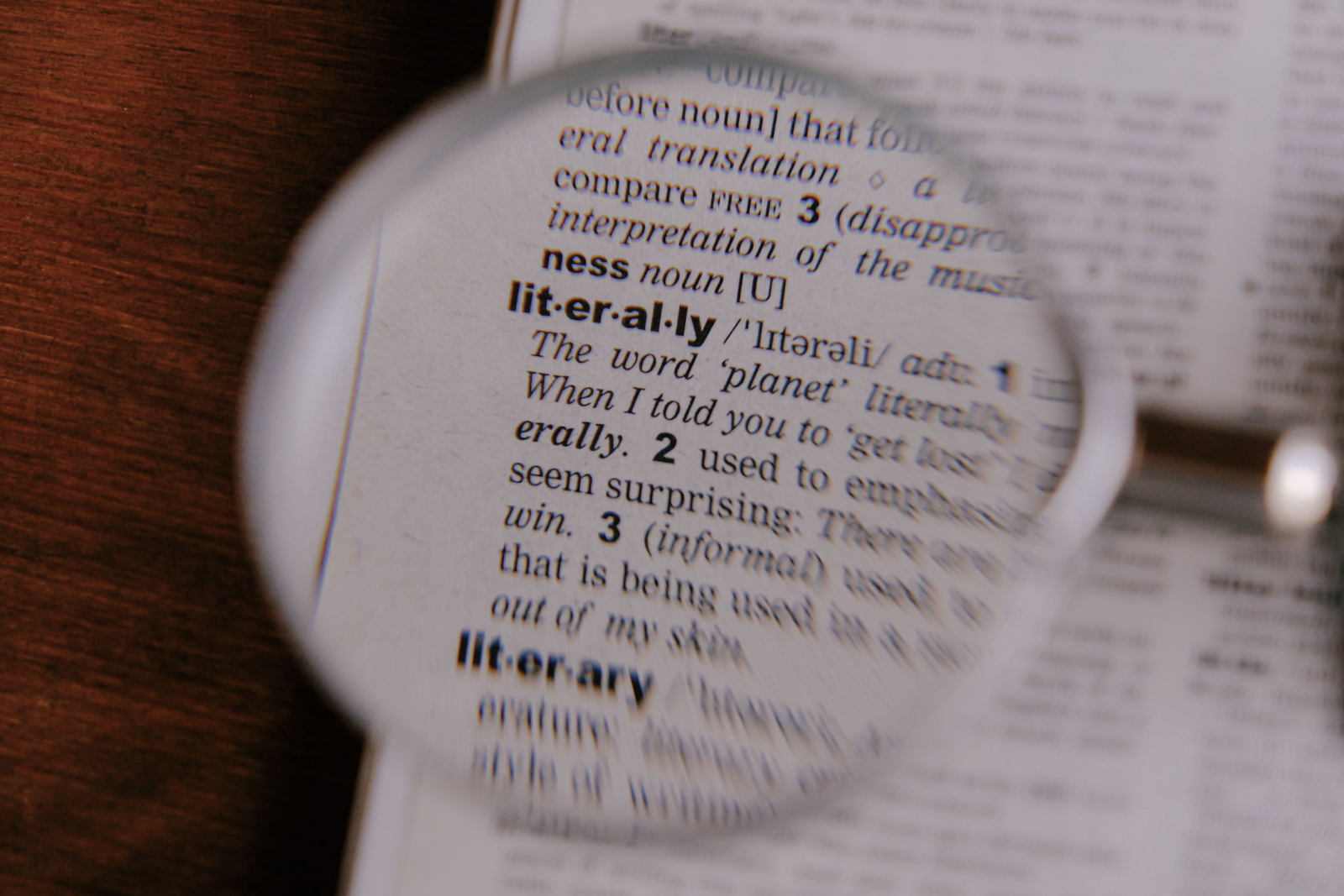
ID 284448124 ©Elif Aytar | Dreamstime.com
Few words attract faster corrections online. The argument usually treats the emphatic use as a recent mistake, even though writers have used it that way for generations.
The primary meaning remains “in a literal sense” or “exactly as stated.” Yet writers have used literally for exaggerated emphasis since the 18th century. “I literally died of embarrassment” isn’t factual, but the emphatic use is established. Keep the word literal in legal, medical, technical, and safety writing, where exaggeration may create real confusion.
30. Peruse
Traditional advice gives this word one careful, scholarly meaning. Actual English usage has been less obedient.
Current dictionaries record both careful examination and casual or leisurely browsing. That makes “She perused the menu and ordered within a minute” possible, though still ambiguous. When the depth of attention matters, studied, examined, skimmed, or browsed tells the reader more.
31. Decimate
The Roman origin is so memorable that it often replaces the modern definition in language lists. History explains the word, but it doesn’t restrict every current use.
The historical Roman punishment involved killing one person in ten. For centuries, decimate has also meant destroying or severely reducing a large part of something. A disease can decimate a population without affecting exactly ten percent. When nothing remains, eradicated or wiped out may be more accurate.
32. Factoid
This word began as a warning about claims that only look factual. Popular usage later pulled it toward the small, entertaining facts people share in quizzes and conversations.
Factoid was coined for an invented or unreliable statement repeated until people accept it as fact. It later acquired another common meaning: a brief, usually trivial, piece of factual information. A “fun factoid” may therefore be true, while another factoid may be misinformation. Use fact, detail, or piece of trivia when accuracy needs to be unmistakable.
33. Entitled
This word now appears so often as criticism that its older, neutral uses can look suspicious even when they are completely correct.
Entitle can give someone a right: “The ticket entitles you to admission,” or “You are entitled to a refund.” It can also give a title to a book, film, painting, or article. “The novel is entitled Middlemarch” is standard English and has centuries of usage behind it. Titled is shorter, though it isn’t the only correct choice.
As an adjective, entitled can also describe someone who expects special treatment or believes they deserve privileges they haven’t earned. “An entitled child” uses that disapproving meaning. The different uses are connected by the idea of having – or believing you have – a right to something.
34. Nauseous
An older distinction still appears in grammar lists and medical conversations. Everyday English has moved beyond the narrow rule.
Current English allows nauseous for both causing nausea and feeling sick. A revolting smell can be nauseous, although nauseating is now more common for the cause, and a person can feel nauseous. Nauseated remains especially clear in medical writing.
35. Unique
The logic seems straightforward: one of a kind can’t become more one of a kind. The complication comes from another established sense of the word.
When unique means literally one of a kind, degrees can sound illogical. The word also has an established sense meaning highly unusual or distinctive, and that sense allows comparison. A design may be fairly unique or very unique – yes, I was surprised to discover this accepted form a while ago -, though distinctive, unusual, or one of a kind may provoke less debate.
36. Enormity
Its resemblance to enormous encourages a size meaning, while older usage points toward moral horror. Modern dictionaries reflect both paths.
Enormity has long described extreme wickedness or a monstrous act, and modern dictionaries also record enormous size, scale, or extent. You can speak of the enormity of a crime or a reconstruction project. Use immensity, scale, or magnitude when you want size without a hint of moral horror.
37. Pristine
An untouched forest and an immaculate hotel room seem to describe different qualities. English has connected them through the idea of something unspoiled.
The older meaning refers to an original, untouched, unspoiled, or uncorrupted state. Modern English also uses pristine for something fresh and clean as if new. A pristine forest is largely untouched; a pristine hotel room is immaculate. Both uses are established.
38. Aggravate
People have objected to the irritation sense for generations, even though it has remained in common use. Formal and informal contexts still treat the word a little differently.
The formal sense is to make a problem, injury, or unpleasant condition worse. Informal English also uses aggravate for making someone angry or irritated. Running may aggravate a knee injury, while repeated notifications may aggravate you. Formal reports often benefit from preserving the difference between worsen and annoy.
39. Fulsome
This may be the riskiest compliment in the article. Depending on the reader, the same phrase can sound generous or embarrassingly insincere.
Fulsome may describe something abundant, generous, or full. It can also mean excessive, overdone, or offensively flattering. “Fulsome praise” may therefore sound heartfelt to one reader and insincere to another. Use generous, enthusiastic, overblown, or insincere when the tone must be clear.
40. Irregardless
People often settle this debate by declaring that the word doesn’t exist. Its real status is more useful than that simple dismissal.
Irregardless appears in dictionaries because it has been used consistently for more than a century. It means the same thing as regardless, but it remains nonstandard and many readers still see it as an error. In formal writing, professional messages, and schoolwork, regardless is the safer choice.
Several words in this section can still send two readers toward different interpretations. Disinterested, nonplussed, fulsome, and peruse all have accepted uses that may remain unclear to part of your audience.
A dictionary can confirm that a meaning exists. It can’t guarantee that every reader will understand the sentence as intended. When the stakes are high, the clearest alternative often wins even when the disputed word is technically defensible.
The Four Sentences From the Beginning: Were They Wrong?
Now that the current meanings are clearer, the four commonly misunderstood words from the opening test can be judged in context rather than through a memorized correction.
“I was ambivalent about leaving a job I loved.” This is correct if the speaker had conflicting feelings: perhaps excitement about a new opportunity and sadness about leaving.
“She perused the menu and ordered within a minute.” This can be correct because peruse may describe casual browsing. Skimmed would tell us more immediately how she read it.
“The disease decimated the local population.” This is standard modern English when the disease severely reduced or damaged the population. No exact ten-percent calculation is required.
“The judge remained disinterested throughout the case.” This is correct if the judge stayed impartial and had no personal interest in the outcome. Impartial may be clearer because disinterested can also mean uninterested.
All four sentences can stand. Two would benefit from a more precise alternative, but none has to be corrected according to current English.
Ten Distinctions Worth Remembering
These ten misused words are likely to help in everyday conversation, professional writing, and media reports.
Ambivalent: pulled between conflicting feelings, rather than simply uninterested.
Incredulous: unable or unwilling to believe; it usually describes the person or their reaction.
Enervated: weakened or drained of energy.
Mitigate: reduce the harm or severity, rather than remove the problem completely.
Exacerbate: make an existing problem worse.
Simplistic: reduced so far that important complexity has been lost.
Penultimate: second to last.
Notorious: widely known, usually for something unfavorable.
Travesty: a distorted or disgracefully inferior representation, rather than a tragedy.
Inflammable: able to catch fire; it means the same as flammable.
How to Choose the Clearest Word
Knowing the correct meanings of commonly misused words is useful, but dictionary permission is only part of good communication. A sentence also has to reach the reader or listener without unnecessary doubt.
In formal writing, choose the least ambiguous option
A report, contract, safety instruction, medical note, or policy document shouldn’t depend on the reader selecting the intended meaning of nonplussed or fulsome. Use the plain word that carries one interpretation in that context.
When writing for an international audience, watch regional meanings
American and British readers may interpret the same word differently. Slang, idioms, and newer meanings can travel unevenly. Literal translations can create another layer of confusion, as the explanations beside these Spanish proverbs with English translations show. A little extra precision is worth more than a word that sounds impressive but leaves half the audience uncertain.
In conversation, match the wording to what you want next
A clear sentence can open a discussion, close it, soften it, or redirect it. The same principle appears in choosing better ways to start a conversation and knowing how to change the subject without being rude. Vocabulary is most useful when it helps the conversation move where you intended.
When a familiar word may distract readers, rewrite it
You don’t have to defend every technically accepted usage. If a word is likely to trigger a correction, a debate, or a second reading, another word may serve the sentence better. The goal is communication, not winning a private argument with an imaginary grammar critic.
Conclusion
The most useful lesson in these 40 words that don’t mean what you think they mean isn’t that everyone is speaking English badly. It is that meanings can be narrower, broader, older, newer, regional, formal, or informal. A correction learned years ago may still be helpful, or it may have become another myth passed from one list to the next.
I enjoy this side of language because it reveals how people think, remember, exaggerate, persuade, and carry expressions across generations. That is also what I love about collecting Romanian proverbs with English meanings: familiar words can hold far more history and nuance than their surface suggests.
Which word surprised you most? And is there one on this list you have been correcting for years?
Frequently Asked Questions About Commonly Misused Words
These are among the questions people ask most often about commonly misused words, accepted newer meanings, and the difference between a genuine error and a disputed use.
What are the most commonly misused words in English?
There is no single authoritative ranking, but frequently discussed examples include ambivalent, literally, nonplussed, peruse, disinterested, decimate, refute, mitigate, travesty, and irregardless. Their difficulty comes from changed meanings, similar-sounding words, regional differences, or an older rule that people still repeat.
Does a word become correct when enough people use it?
A new meaning may become established when it appears widely, consistently, and for a sustained period among speakers and writers who understand it in the same way. Dictionaries document that evidence. A recorded meaning may still be informal, regional, disputed, or unsuitable for a particular type of writing.
Can literally mean figuratively?
Literally can be used informally as an exaggerated intensifier for a statement that isn’t factually literal. That use has existed for centuries and appears in current dictionaries. It is still better avoided when readers need to know whether an event truly happened exactly as described.
Does peruse mean skim or read carefully?
It can mean either. Peruse has been used for careful examination and for casual or leisurely browsing. Since the meanings can conflict, use skimmed, browsed, studied, or examined closely when the degree of attention is relevant.
Is irregardless a real word?
Yes. Irregardless is recorded because it has a long history of use, but it remains nonstandard. Regardless means the same thing and is the better choice in formal writing, professional communication, and schoolwork.
Can a book be entitled?
Yes. Entitle has long meant giving a title or name to a work. “The book is entitled…” and “The book is titled…” are both correct.
Is disinterested the same as uninterested?
The meanings can overlap in modern English, but disinterested is especially useful for someone who is impartial or has no personal stake in an outcome. Uninterested is clearer when a person is bored or lacks curiosity.
What is the difference between a misused word and a commonly confused word?
A misused word is given a meaning it doesn’t normally carry in that context, such as using mitigate to mean completely eliminate. Commonly confused words are two related or similar-looking words that get exchanged, such as infer and imply or exacerbate and exasperate.
Why do dictionaries include meanings that people still call wrong?
Dictionaries describe established language use rather than preserving only the oldest definition. A meaning can be widespread enough to record while remaining controversial or informal. Labels and usage notes help readers decide whether it suits the audience and setting.
How can I avoid using a word incorrectly?
Check the word in more than one current dictionary, read the example sentences, and pay attention to labels such as informal, chiefly US, British, dated, or nonstandard. When two meanings could fit, replace the word with a more precise alternative. The same habit improves broader conversation skills and helps prevent the conversation mistakes that make people lose interest.
Featured image created with ChatGPT
More amazing articles for you:

Violeta-Loredana Pascal is a communications expert, business mentor, and the founder of Earth’s Attractions and PRwave INTERNATIONAL. A pioneer in the Romanian digital PR landscape since 2005, she holds a degree in Communication and Social Sciences from SNSPA Bucharest. Violeta is a senior trainer at AcademiadeAfaceri.ro, where she leverages over 20 years of experience to teach professional courses in PR strategy and workplace productivity. By blending high-level business consulting with a passion for holistic travel and wellness, she empowers solopreneurs to overcome procrastination, build profitable brands, and design a life of purposeful adventure.