UN Peace Decade Vote Carries Powerful Message for Global Tourism
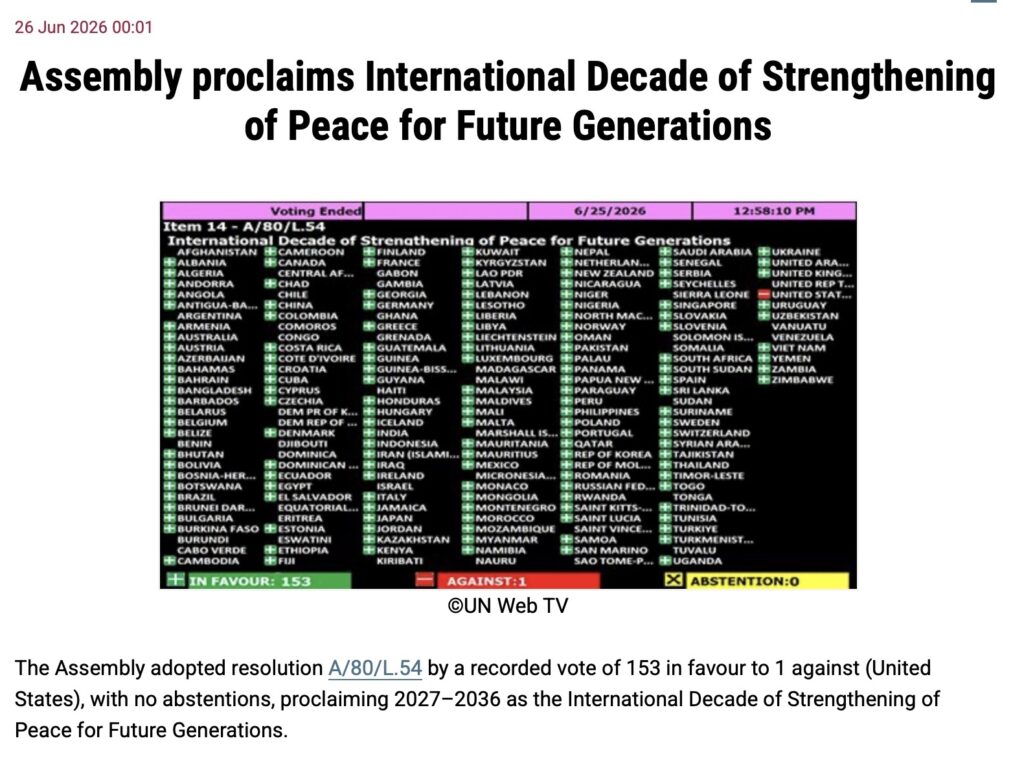
The UN has proclaimed 2027–2036 the International Decade of Strengthening Peace for Future Generations, with 153 nations voting in favor and the United States casting the only opposing vote. This opinion piece, published in recognition of an article released today by Travel Impact Newswire, explores what the decision means for global tourism.
In a world weary from wars, geopolitical tensions, and growing uncertainty, the United Nations General Assembly has taken a symbolic but significant step by proclaiming 2027–2036 as the International Decade of Strengthening Peace for Future Generations. The resolution, adopted on June 25, passed with overwhelming international support: 153 countries voted in favor, one voted against, and none abstained. The lone opposing vote came from the United States.
That vote deserves attention—not because UN General Assembly resolutions are legally binding, but because symbols matter. They shape global narratives, influence diplomacy, and signal where nations stand on issues that transcend borders.
The resolution, initiated by Tajikistan and supported by a diverse coalition of countries from multiple regions, calls for a decade dedicated to promoting dialogue, reconciliation, and peaceful coexistence, and to ensuring that the interests of future generations are incorporated into policymaking. It also reinforces commitments made in the 2024 Pact for the Future and echoes the founding promise of the UN Charter to “save succeeding generations from the scourge of war.”
For the travel and tourism industry, the message could not be more relevant.
UN proclaims 2027-2036 as “Decade of Peace for Future Generations”, US casts sole vote against
Bangkok — The United Nations General Assembly has proclaimed the period 2027–2036 as the International Decade of Strengthening of Peace for Future Generations. In…
Tourism cannot Thrive Without Peace
Travel has always been one of humanity’s greatest peace projects. Every international arrival represents an act of trust. Every cultural exchange reduces ignorance. Every destination that welcomes visitors benefits from stability, openness, and cooperation.
Tourism contributes more than economic growth. It creates relationships between people who might otherwise never meet. It builds understanding that governments often struggle to achieve through diplomacy alone.
This is why organizations such as the UN World Tourism Organization (now UN Tourism) have long argued that tourism is a force for peace. Destinations recovering from conflict frequently rely on tourism as one of the first industries capable of rebuilding livelihoods and restoring international confidence.
Without peace, there is no tourism.
The Question Raised by Washington’s Vote
The United States has not publicly framed its opposition as a rejection of peace itself. UN voting often reflects concerns about specific wording, procedural issues, or broader diplomatic considerations rather than disagreement with a resolution’s stated goals.
Nevertheless, diplomacy is judged as much by perception as by explanation.
To much of the international community, the image is simple: virtually every UN member supported a decade dedicated to strengthening peace for future generations, while one country stood apart.
That perception inevitably raises questions. Why oppose a declaration centered on dialogue, reconciliation, and future generations? Was the objection procedural, political, or philosophical? Unless clearly explained, the symbolism risks overshadowing the rationale.
A Reminder of Why the UN Exists
The United Nations was created after World War II with a singular mission: to prevent humanity from repeating its darkest chapters.
The new decade is not a peace treaty. It does not end wars or compel governments to change policies. It is a framework encouraging education, cooperation, intergenerational dialogue, and peaceful conflict resolution.
Critics may dismiss such initiatives as symbolic diplomacy.
History, however, shows that symbols often precede action. International decades have helped focus global attention on literacy, sustainable development, biodiversity, and human rights. They create common goals, encourage partnerships, and provide governments and civil society with a shared agenda.
Why This Matters to Travel
For the travel industry, peace is not an abstract concept—it is the foundation upon which every airline route, hotel investment, cruise itinerary, and tourism business depends.
Travel journalists regularly report on destinations disrupted by conflict, natural disasters, or political instability. Conversely, they also witness remarkable recoveries when peace returns.
The industry, therefore, has a unique voice in conversations about peace. Tourism reminds the world that behind every geopolitical headline are ordinary people whose livelihoods depend on visitors feeling safe enough to travel.
An Opportunity Rather Than a Division
Perhaps the most valuable lesson from this UN vote is not the overwhelming support or the solitary opposition. It is the reminder that peace remains an ongoing process rather than a finished achievement.
Governments will continue to disagree. Diplomacy will continue to evolve. But future generations will judge today’s leaders not only by the wars they fought or avoided, but by whether they created conditions in which cooperation could flourish.
The International Decade of Strengthening Peace for Future Generations is, ultimately, an invitation—not a guarantee.
The travel and tourism sector should accept that invitation.
Because every passport stamped, every border crossed in friendship, and every conversation between strangers is another small investment in the peaceful world the United Nations hopes future generations will inherit.