Walking tour of Fort Kochi

Churches, Museums, Chinese Fishing nets and more
Also see: Travelogues from Kochi (Cochin)
Fort Kochi is a living museum where history breathes through every cobblestone and seaside breeze. This historic seaside neighbourhood in Kerala serves as a captivating gateway to a bygone era. It beautifully blends centuries of maritime heritage with a thriving modern art scene.

Fort Kochi
Top row, left to right: Dutch Cemetery, Sunset at Fort Kochi Beach and Display at Indian Naval Museum
Bottom row, left to right St. Francis Church, Interior of Santa Cruz Cathedral and Streets of Kochi
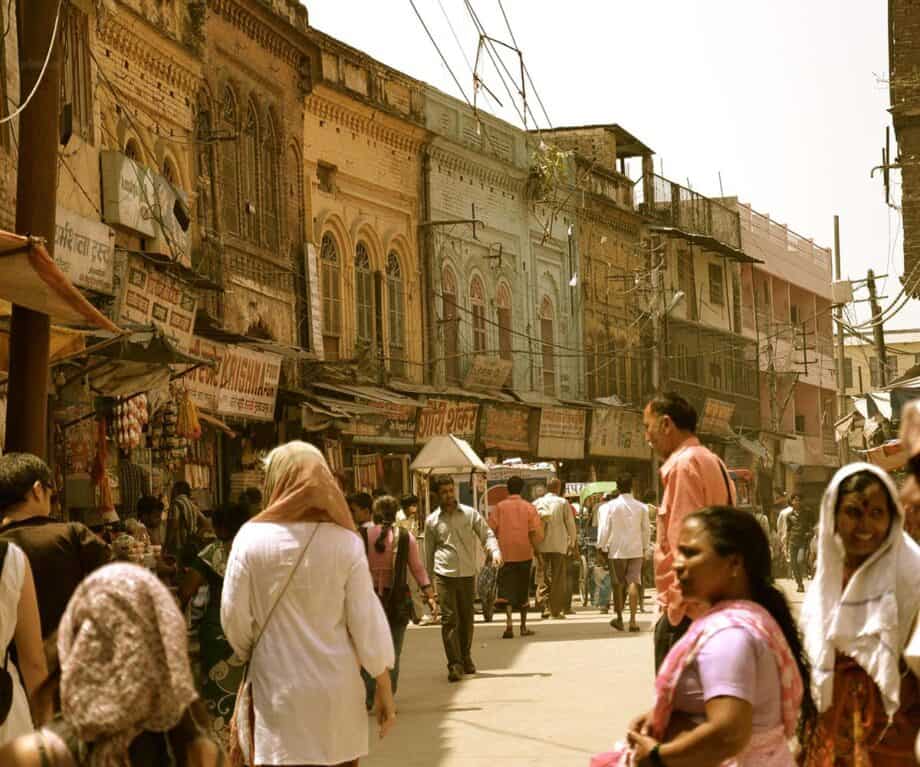
As one steps into Fort Kochi, the frantic pace of modern-day life melts away into a world of shadowed alleyways and giant rain trees. A walk through the streets of Kochi traces a journey through a town that not only preserves its past but also blends with the modern-day world.

Kochi Streets
Fort Kochi Timeline:
- Portuguese (1500 – 1663): In 1500, the Portuguese got the trading rights from the local king. The fort came up in 1503 and was initially known as Fort Emmanuel (or Fort Manuel)
- Dutch (1663 – 1795): They dismantled much of the original fort and added fortification with massive bastions. They revamped much of the town’s existing infrastructure and architecture.
- British (1663 – 1947): The fort’s defensive walls were mostly dismantled by 1806, and the settlement becomes a prominent administrative outpost for the spice and tea trade.
- Post-independence (1947 – today): It is now known as Fort Kochi. It functions as a heritage and cultural district, celebrated for its well-preserved colonial bungalows converted into hotels, museums, cafes and art galleries

Streets of Kochi Fort
The walking tour of Fort Kochi includes:
- Indian Naval Maritime Museum
- Dutch Cemetery
- Indo-Portuguese Museum
- VOC Gate
- Santa Cruz Cathedral
- St. Francis Church
- Bastion Bungalow
- Fort Kochi Beach
Indian Naval Maritime Museum (Google map location): The Indian Naval Maritime Museum is a museum dedicated to the maritime history and heritage of the Indian Navy. It is located in the historic naval base of INS Dronacharya in Kochi. It serves as a valuable repository of naval history and heritage.

An assortment of gums displayed at the compound of Indian Naval Maritime Museum
The museum resides within the formidable walls of two World War II bunkers. The bunkers were considered by the British in 1938.
These fortified underground structures have been cleverly repurposed into the museum’s galleries.
The museum traces the evolution of the Indian Navy through models and write-ups. It has a display of model helicopters, aircraft and ships.
There is a dedicated gallery that highlights strategic details and naval victories from the Indo-Pakistani War of 1971.
Another gallery focuses on Kerala’s early seafaring origins and foreign trade links and the arrival of Vasco da Gama. Murals, paintings and figurines depict the journey of Vasco da Gama and mention Kanji Malam, a Kutchi sailor and spice trader who steered Vasco da Gama from Africa to India.

Statue of Kanji Malam, a Kutchi sailor and spice trader who steared Vasco da Gama from Africa to India
The open ground of the museum exhibits a host of objects, which include radars, anti-aircraft guns and even a helicopter.
Necessary information on the Indian Naval Maritime Museum:
- Timings: Tuesday – Friday: 9:30 am – 1:30 pm and 2:30 pm – 5:30 pm. Saturday & Sunday: 9:30 am – 1:30 pm and 2:30 pm – 8:00 pm
- Tickets: Indian adult (above 12 yrs): ₹50, Foreign adult (above 12 years): ₹200. Indian children (below 12 years): ₹25 and Foreign children (below 12 years): ₹50
- Photography: Allowed, charges applicable.Still camera (Indian): ₹100 and still camera (foreigner): ₹200. Video camera (India): ₹200 and Video camera (forigner): ₹300

Dutch Cemetery, Kochi
Dutch Cemetery (Google map location): Established in 1724, the Kochi Dutch Cemetery in Fort Kochi is the oldest European cemetery in India. The cemetery has 104 tombs and epitaphs reflecting the colonial history of the Dutch Malabar region.

Indo Portuguese Museum
The cemetery is the resting place of Dutch governors, commanders, and merchants. The last burial took place in 1913, belonging to Captain Joseph Ethelbert Winckler.
Cemetery features traditional Dutch colonial-era tombs built with granite and red laterite. None of the tombs features a cross (similar to the Dutch Cemetery in Chinsurah (Cuchura), West Bengal.
Necessary information on Kochi Dutch Cemetery: Usually locked and can be viewed from the outside
Indo-Portuguese Museum (Google map location): The Indo-Portuguese Museum, located within the lush gren compound of the Bishop’s House in Fort Kochi. Established in 2000 through the vision of the late Dr. Joseph Kureethra, Bishop of Kochi, the museum showcases a rare collection of a 16th-century teak altar, silver processional cross, and heritage pieces from the Bishop’s House.
Necessary information on the Indo-Portuguese Museum:
- Timings: 10:00 am – 5:00 pm
- Tickets: Indian adult: ₹10, Foriegn adult: ₹25 and childern: ₹5
- Photography: Not allowed

VOC Gate, Fort Kochi
VOC Gate (Google map location): The VOC stands for the Vereenigde Oostindische Compagnie, known in English as the Dutch East India Company. Established in 1602 it was the world’s first multinational corporation and the first company to issue public stock. At its peak, it was arguably the wealthiest private company in history, possessing its own private army, navy, and the legal right to wage wars and execute prisoners. VOC Gate refers to the white masonry gate marked with the monogram VOC 1740. It stands next to the Fort Kochi Parade Ground and leads to the Kara Hotel.
Necessary information on VOC Gate: Public place open all day

Santa Cruz Cathedral
Santa Cruz Cathedral (Google map location): The original church dates back to 1505 and was built by the Portuguese. During the Dutch period, which began in 1663, the church was spared from destruction but was used as a storehouse. However, when the British took over Fort Kochi in 1795, the original church was demolished.

Interior of Santa Cruz Cathedral
The milk-white church with its twin towers follows a Gothic and Indo-European architectural style.
The art-filled interiors consist of stained glass windows, murals, paintings and figurines in vivid colours.
The church was elevated to the status of a Basilica in 1984 by Pope John Paul II.
Necessary information on Santa Cruz Cathedral:
- Timings: 7:00 am – 6:30 pm
- Tickets: Non tickted
- Photography: Allowed
St. Francis Church (Google map location): Built in 1503, the St. Francis Church is the first European church built in the Indian sub-continent. Architectural elements of the church combine early European colonial concepts with indigenous adaptation to suit Kerala’s heavy monsoon climate.

St Francis Church, Kochi
The exterior walls of the church are supported by five heavy lateral buttresses on each side to sustain the building’s weight. The corner buttresses feature diagonal placement topped by pyramidal spires.

Interior of St. Francis Church, Kochi
The church was originally constructed by the Portuguese. The Dutch took over the church in 1663, followed by the British in 1795.
The church was the final resting place of the Portuguese explorer Vasco da Gama. He died in Kochi in 1524 and was buried here for 14 years before his remains were taken to Lisbon.
The exact spot of his burial has been marked by a plaque. The interior contains several other burial plaques.
The hand-pulled cloth fans (pankahs) from the British era, which are still suspended from long iron rods, can be seen to this day.
Necessary information on St. Francis Church, Kochi:
- Timings: 7:00 am – 6:30 pm
- Tickets: Non-ticked
- Photography: Allowed

Bastion Bungalow, Kochi
Bastion Bungalow (Google map location): The Fort Kochi refers to the Portuguese Fort Emmanuel (or Fort Manuel). After the Dutch took charge of the region in 1663, they strengthened the fort with several bastions, including the Stroomburg Bastion. In 1667, the Stroomburg Bastion was topped with a beautiful bungalow, which was popularly known as Bastion Bungalow.

Bastion Bungalow Museum exhibits
After the British took over in 1806, they demolished large sections of the fortification but spared the bastion and the bungalow.
Today, the historic bungalow has been converted into a museum exhibiting the history of the spice trade and history of the port of Kochi.
The exhibits include rare maps, letters, and art portraying the arrival and political intervention of European powers—the Portuguese, the Dutch, and the British and also include a model Dutch kitchen.
Necessary information on Bastion Bungalow:
- Timings: 10:00 am – 1:00 pm and 2:00 pm – 5:00 pm (Monday closed)
- Tickets: Indian adult (above 12 yrs): ₹35, Foreign adult (above 12 years): ₹350. Indian children (below 12 years): ₹10 and Foreign children (below 12 years): ₹100
- Photography: Mobile ₹10 and camera ₹200

Chinese fishing nets, Fort Kochi Beach
Fort Kochi Beach (Google map location): Long before the Europeans arrived, Kochi (or Cochin) had been a flourishing port and an important trade centre of the world. It played an important role in the spice trade. It stood at the crossroads of sea routes connecting Southeast Asia and Arabia. Even today, Kochi serves as an important port with its gigantic cranes towering above the Kochi skyline.

Fort Kochi Beach Sunset
The skyline of Kochi is dominated by another towering structure, which, unlike the port cranes, dates back several centuries.
These Chinese fishing nets were said to have been introduced in Kochi by the 14th-century Chinese admiral and diplomat Zheng He.
These Chinese fishing nets are a unique feature of the small beach of Fort Kochi. These nets are only found in Kochi and nearby areas.
The beach is small and not very scenic. It is still offers a spectacular sunrise. Street vendors line up the beach selling souvenirs and tasty snacks.
More on:
X

Squid and appam, Fort Kochi lunch
Food at Fort Kochi: Fort Kochi is a foodies paradise. The streets are lined with restaurants and cafes selling continental and local cuisines.
The local fair consists of seafood (fish, shrimps, prawns, crabs, squids, octopus and more) along with beef dishes (beef fry being the most popular).
These dishes can be paired with appum, putto or the crispy Malabar parothas. (Lunch for 2 will cost around ₹500 – 600)
The street shacks along the Fort Kochi sells an assortment of fast food, including fried fish and seafood. The list also include roasted corn, ice-creams, spicy cut fruits and many more. (Snacks for 2 will cost around ₹200 – 300)
Travel Tips:
- Map of the walk: Route on Google map
- Walk schedule:
- Start at 12 noon from the Indian Naval Maritime Museum
- After VOC Gate, head for lunch at 2:00 pm (aprox)
- Finish Bastion Museum at about 4:30 pm and head for the Fort Kochi Beach
- Watch the sunset at the beach and enjoy evening snacks
- Note: This timing is advisable for winter months (Nov – Feb) only
Kochi consists of Fort Kochi, Mattancherry, Ernakulam and the islands of Vypin Island, Vallarpadam, Willingdon and Bolgatty
More:
X